

Sudden household blackouts and grid flickers can instantly disrupt remote work routines, shut down home internet routers, and cut off vital family communication. Having dependable backup electricity on hand prevents the stress of watching your phone drop to zero during an unexpected weather emergency. Selecting the best power bank for home means looking beyond pocket-sized smartphone bricks toward versatile high-capacity units with multi-port distribution, pure sine wave AC sockets, and long-life LiFePO4 battery chemistry. While everyday commuters might prioritize a slim best portable charger for travel, household resilience demands steady watt-hour reserves that keep laptops, lamps, and basic electronics running for hours.
Based on product specifications and verified user feedback, today’s compact home power stations bridge the gap between lightweight mobile batteries and noisy gas generators. Modern units offer fast wall recharge times, integrated solar input options, and fast-charging USB-C Power Delivery up to 100W for modern laptops and tablets. Evaluating battery life cycles, continuous output wattage, and surge capabilities ensures your chosen system can handle essential loads safely without overheating or shutting down prematurely.

Pros
- Extremely fast wall charging compared to similar capacity units.
- Safe, long-lasting LiFePO4 chemistry with built-in BMS protection.
- Quiet operation with no fumes, suitable for indoor emergency backup.
- Compact size and integrated handle for easy transport and storage.
Cons
- Solar panels sold separately, adding to overall cost.
- App required for 1-hour fast charging; default is 1.7 hours.
- Limited to 1500W continuous output, may not run high-draw appliances like large heaters.
The Jackery Explorer 1000 v2 is a portable power station designed to deliver reliable, silent electricity for camping, RV trips, emergency preparedness, and off-grid living. With a 1070Wh LiFePO4 battery and a 1500W pure sine wave inverter (3000W surge), it can power essentials like mini-fridges, CPAP machines, lights, laptops, and small appliances. Its compact size and 23.8-pound weight make it one of the most portable options in its class, and the foldable handle adds convenience for loading into a vehicle or carrying to a tailgate.
This unit is best suited for campers, RV owners, van lifers, tailgaters, and homeowners preparing for power outages. Remote workers who need backup for laptops and monitors will also appreciate the 100W USB-C PD port and three AC outlets. The LiFePO4 battery chemistry provides over 4,000 charge cycles to 70% capacity, translating to a lifespan exceeding 10 years with normal use. According to product specifications, the built-in Battery Management System (BMS) protects against overcurrent, short circuits, and temperature extremes, ensuring safe operation indoors or out.
Performance-wise, the Explorer 1000 v2 stands out for its charging speed. With the Jackery app, you can activate emergency charging and go from 0% to 100% in about one hour. The default mode charges in 1.7 hours, which still beats many competitors. Solar charging is supported (panels not included) via a separate input, making it a viable companion for extended off-grid trips. The unit includes three 120V AC outlets, one USB-A (18W), two USB-C (30W and 100W), and a 12V car port, offering plenty of flexibility for charging phones, tablets, cameras, and small electronics simultaneously.
Build quality is solid with a plastic housing that feels durable enough for campsite use. The front panel features a clear LED display showing remaining battery percentage, input/output wattage, and estimated runtime. The fan is quiet during normal operation, though it may ramp up under heavy loads. The unit operates in temperatures from 14°F to 113°F, making it suitable for most American climates. Storage is straightforward: keep it in a dry place, and recharge every few months to maintain battery health.
Realistic limitations include the need to purchase solar panels separately for off-grid recharging, and the 1500W continuous output may not support high-wattage appliances like space heaters or large air conditioners. The app is required to enable the fastest charging mode, which some users may find inconvenient. Additionally, while the weight is manageable, it's not designed for backpacking; it's best for car camping, RV storage, or home emergency kits.
Overall, the Jackery Explorer 1000 v2 offers an excellent balance of capacity, portability, and charging speed for outdoor enthusiasts and emergency preppers. Its long battery life and safe LiFePO4 chemistry make it a trustworthy power source for weekend camping trips, hurricane season backup, or daily use in a van or RV. For anyone seeking a reliable portable power station without the noise and fumes of a gas generator, this is a strong recommendation.

Pros
- Very lightweight and compact at 2.3 lbs, easy to toss in a backpack or glove compartment.
- Offers both AC and DC outputs, including USB-C and QC 3.0, so you can charge a wide variety of devices.
- Simple one-button operation with clear LED display showing remaining battery and charging status.
- Quiet, no-fume operation compared to gas generators, ideal for indoor emergency backup or close-quarters camping.
- Budget-friendly price point for a portable power station with AC outlet capability.
Cons
- 88Wh capacity is limited; cannot power larger appliances like mini-fridges, CPAP machines overnight, or power tools for long periods.
- Solar panel not included, and the 18W USB-C is not enough for fast-charging most newer laptops.
- AC output is modified sine wave (based on typical budget units), which may not be ideal for sensitive electronics without checking compatibility.
The HOWEASY H120 is a compact portable power station that delivers 120 watts of continuous AC power (240W peak) from its 88Wh lithium-ion battery. Designed for campers, RV owners, road trippers, emergency preppers, and anyone needing a lightweight backup power source, this unit fits easily into a backpack or glove compartment, weighing just 2.3 pounds. Its bright orange and black casing makes it easy to spot in a crowded campsite or during a blackout.
Based on its specifications and user feedback, the H120 offers a practical solution for charging smartphones (up to 5-6 full charges), tablets, cameras, mini fans, string lights, and small electronics. The eight output ports include two 110V AC outlets, two USB-A ports (one QC 3.0), one USB-C (18W), two 12V DC outlets, and a built-in LED flashlight with three modes. The LED display clearly shows remaining battery level, helping you manage power usage during a weekend camping trip or a power outage.
Charging the H120 is flexible: you can use the included AC wall adapter (takes about 5-6 hours), a car charger (included), or a compatible solar panel (sold separately, 20-60W recommended). The pass-through charging feature lets you power devices while the unit itself charges, which is handy for keeping essentials running during a road trip or at a tailgate party. The built-in Battery Management System (BMS) protects against over-voltage, over-current, short circuits, and temperature issues, ensuring safe operation in most environments.
In terms of build quality, the H120 feels solid for its size, with a rubberized base that helps it stay put on uneven surfaces. The integrated handle is cleverly hidden but comfortable to carry. However, the 88Wh capacity means it won't run a CPAP machine all night, a mini fridge, or power tools for extended periods. As noted in the product's FAQ, runtime is roughly 85% of capacity divided by the device's wattage, so keep expectations realistic for larger loads. The AC output is likely modified sine wave, which is fine for most phone chargers, LED lights, and small appliances, but not ideal for sensitive medical equipment or certain audio gear.
The H120 shines as a grab-and-go power source for short outdoor adventures, emergency kits, and day trips. It's also airline-approved (under 100Wh), making it a great travel companion for flights where you need to keep devices charged. For longer off-grid stays or heavy power needs, you'd want a larger capacity unit from the same brand (like the EA300). But for the price and size, the HOWEASY H120 delivers a reliable, portable energy solution that many campers, hikers, and preppers will appreciate.
The HOWEASY H120 packs an 88Wh (24,000mAh at 3.7V) lithium-ion battery, built to last over 1,500 charge cycles with proper care. According to product specs, a full charge via wall adapter takes about 5-6 hours, while car charging is similar. Solar charging time depends on panel wattage and sun conditions (typically 8-12 hours with a 30W panel).
Estimated runtime examples: charge a smartphone (10-15Wh) 5-6 times; run a 5W LED light for 15 hours; power a 30W mini fan for 2.5 hours; or run a 60W laptop for about 1 hour. Always factor in the 85% conversion efficiency noted by the manufacturer. The LED display helps you monitor remaining charge in real time.
For best battery longevity, avoid deep discharges and store the unit in a cool, dry place. The BMS protects against overcharge and over-discharge, making this a safe battery for everyday use.
Weighing just 2.3 pounds and measuring 6.6 x 4 x 3 inches, the H120 is one of the most portable power stations with an AC outlet on the market. Its orange and black housing is easy to spot, and the hidden handle at the top makes carrying it as simple as grabbing a small lunchbox. The rubberized bottom adds grip on tables or tent floors.
The unit's compact size means it can fit in a cup holder, backpack side pocket, or glove box. The built-in LED flashlight with steady, flash, and SOS modes is a nice bonus for emergencies. All ports are clearly labeled, and the separate AC/DC power buttons let you control which outlets are active, saving battery when not in use.
While not weather-sealed, the plastic casing feels durable enough for typical camping conditions if kept dry. The overall design prioritizes lightweight convenience over ruggedness, making it ideal for ultralight campers and travelers.
The H120 features eight output ports: two 110V AC outlets (2-prong and 3-prong), two USB-A ports (one QC 3.0 up to 18W, one standard 5V/2.4A), one USB-C port (18W PD), two 12V/10A DC barrel ports, and a power button with built-in LED display. The AC outlets can deliver up to 120W continuous (240W peak), ideal for small electronics like phone chargers, laptops under 120W, mini fans, and CPAP machines (though not all night due to capacity).
USB-C 18W can fast-charge many modern phones and tablets but may not be enough for high-wattage laptops. The QC 3.0 USB-A port is great for quick charging Android devices. The two DC ports are perfect for car accessories like coolers, tire inflators, or 12V LED lights. All ports can be used simultaneously as long as total draw stays under 150W peak.
Check your device's wattage before plugging in; if it exceeds 120W, the H120 won't power it. For sensitive electronics (like some medical devices or audio gear), keep in mind that the AC output is likely modified sine wave, which may cause buzzing or inefficiency.
For emergency preparedness, the H120 is a lightweight addition to any bug-out bag or car emergency kit. Its 88Wh capacity can keep a phone running for days with careful use, power a weather radio, charge a headlamp, and run a small fan or light during a power outage. The SOS flashlight mode is a crucial safety feature for signaling or navigating in the dark.
While it won't run a refrigerator or sump pump, it's perfect for keeping essential communication devices and small appliances alive during short outages. The ability to recharge via solar or car makes it suitable for extended emergencies where grid power is unavailable. For longer blackouts, consider pairing it with a 50W solar panel for daily top-ups.
Many preppers appreciate the quiet operation and lack of fumes compared to gas generators, allowing safe indoor use (but still ensure ventilation). The H120's airline-approved status also means you can bring it on evacuation flights.

Pros
- Remarkably compact and lightweight for the capacity, easy to toss in a backpack or glove compartment.
- Fast recharge capability (0-80% in 1.5 hours) means less downtime between uses.
- Multiple output ports including AC outlets, so you can power laptops, small appliances, and USB devices at once.
- LiFePO4 battery chemistry offers excellent longevity and safety, with thousands of charge cycles.
- Quiet operation with no loud fan, making it suitable for indoor or tent use.
Cons
- Limited to 100W continuous output, so it cannot run high-power appliances like heaters, kettles, or large refrigerators.
- Pass-through charging uses charge/discharge method rather than direct pass-through, which may stress the battery over time.
- Some users report a faint humming noise under load, though not disruptive in most environments.
The DARAN R100 Portable Power Station is a compact, lightweight power bank that bridges the gap between a standard USB power bank and a full-sized generator. With a 28,000mAh (89.6Wh) LiFePO4 battery and a 100W continuous output (200W surge), it's designed to keep your essential electronics running during camping trips, RV adventures, road trips, tailgating, power outages, and everyday use.
This unit is best suited for campers, RV owners, outdoor enthusiasts, emergency preppers, remote workers, van lifers, tailgaters, and anyone who needs a reliable, portable backup power source for low-wattage devices. It excels at charging smartphones, tablets, laptops, cameras, drones, mini-fridges, CPAP machines, LED string lights, and small fans. However, it won't run high-draw appliances like space heaters, electric kettles, or air conditioners.
Performance-wise, the R100 delivers solid runtime for its size. According to user feedback and specifications, it can power a typical laptop (45W) for about 2 hours, charge a smartphone multiple times, or keep a mini-fridge running for a couple of hours. The 100W AC output is pure sine wave, which is safe for sensitive electronics. Charging the station itself is impressively fast: using the AC wall charger and USB-C simultaneously, you can go from 0 to 80% in about 1.5 hours. It also supports solar charging (up to 40W via DC5521), making it a viable option for off-grid recharging.
Build quality is a standout feature. The LiFePO4 battery chemistry offers over 3,500 charge cycles, far outlasting standard lithium-ion batteries. The unit includes a comprehensive battery management system (BMS) with protection against overvoltage, overcurrent, short circuits, and temperature extremes. The casing is made from ABS plastic, which feels sturdy yet lightweight. The LED display clearly shows remaining battery percentage, though it's basic and doesn't show runtime estimates. The built-in flashlight with four brightness levels and SOS mode is a practical addition for emergencies.
Ease of use is straightforward: just plug in your devices and press the power button. The unit is silent during operation (no fan), though some users have noted a faint humming when powering devices under load. Storage is simple: turn it off, keep it in a dry, room-temperature place, and recharge every three months to maintain battery health. The included components are minimal (just the power station), so you'll need to supply your own wall charger, USB cables, and solar panel if desired.
Realistic limitations include the 100W cap, which means you can't run power-hungry gear. Also, the pass-through charging method is the charge/discharge type rather than direct pass-through, so it's best to charge the station fully before using it to power devices. A few users have reported that the unit didn't last as long as expected with very low-power loads (like string lights), but that may be due to the inverter's overhead. Overall, the DARAN R100 offers excellent value for its price point, providing a reliable, portable, and safe power solution for anyone who needs to keep their electronics charged on the go or during emergencies.
The DARAN R100 features seven output ports: two AC outlets (100W total, pure sine wave), two USB-C ports (one 45W PD, one 15W), two USB-A ports (one 18W QC, one 15W), and one DC5521 port (60W). This variety allows you to charge laptops, phones, tablets, cameras, and small appliances simultaneously. The USB-C PD port can fast-charge compatible laptops and phones. For input, the station supports AC wall charging (via included cable), USB-C PD charging (up to 45W), car charging, and solar charging (up to 40W via DC5521). The dual input capability (AC + USB-C) enables ultra-fast charging from 0-80% in about 1.5 hours. Note that the solar panel is not included, but any 40W panel with DC5521 output can be used.
Pros
- Compact and lightweight design makes it easy to carry and store.
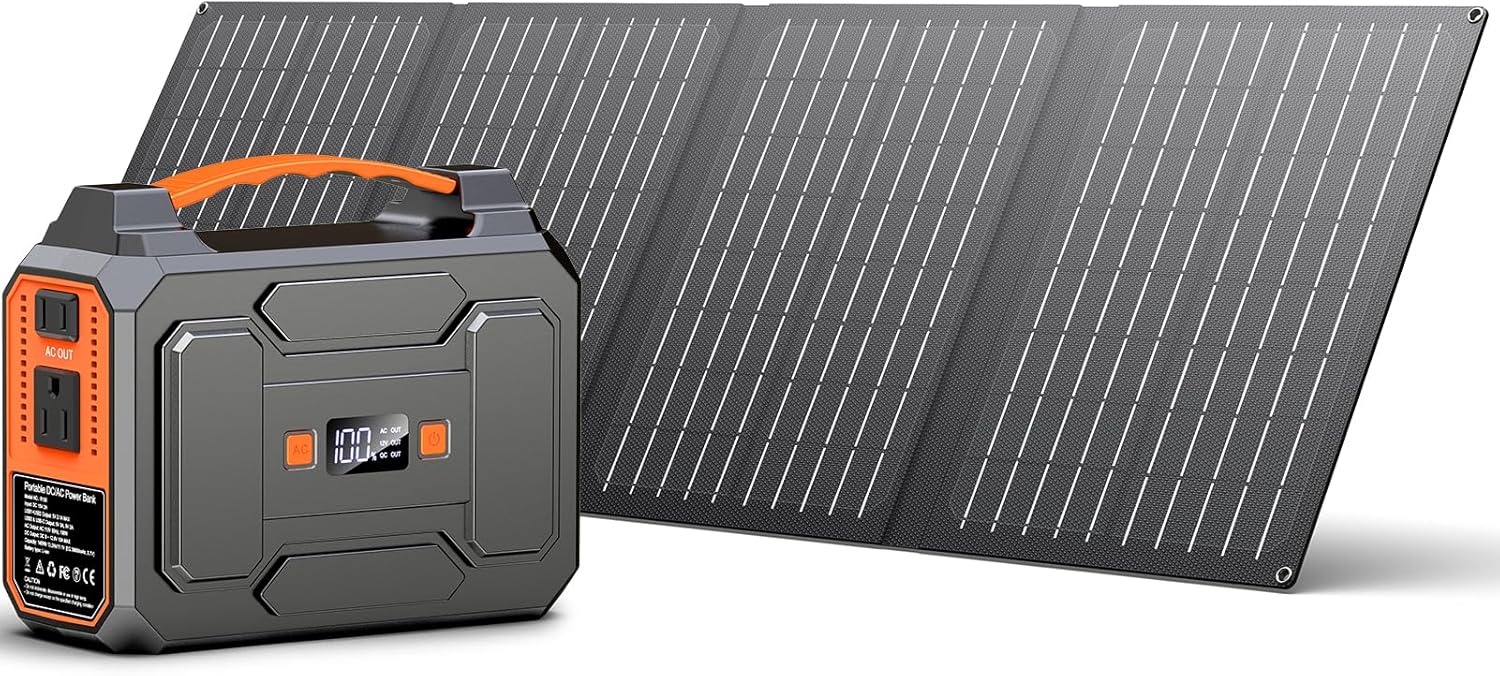
- Includes a 40W solar panel and multiple cables for out-of-the-box use.
- Dual AC outlets provide flexibility for small appliances.
- LED display shows real-time input/output for easy monitoring.
- Quiet operation with no fumes, perfect for indoor use during emergencies.
Cons
- Limited 146Wh capacity may not run larger devices like refrigerators or power tools for long.
- Solar charging can be slow on cloudy days or in winter; full recharge via solar may take 6-8 hours in optimal sun.
- Some users report the solar panel may not be compatible with other power stations, and customer support response times vary.
The Apowking R100 portable power station is a compact solar generator that combines a 146Wh lithium-ion battery with a 100W rated (200W peak) inverter and a 40W folding solar panel. Designed for campers, RV owners, road trippers, and emergency preppers, it provides a clean, quiet power source for charging phones, tablets, laptops, small fans, and LED lights during weekends away or unexpected outages.
Based on product specifications and user feedback, this unit delivers enough juice for multiple charge cycles on smartphones (roughly 10-15 full charges) or a few laptop top-ups. The two standard 110V AC outlets output pure sine wave power, ensuring sensitive electronics run smoothly. Additional USB-A (5V/3.1A), USB-C with Quick Charge 3.0, and a 12V car port cover most small device needs. The included 40W monocrystalline solar panel charges the station steadily in direct sunlight, typically taking 6-8 hours for a full recharge, while the AC wall adapter cuts that to about 3 hours.
Build quality is respectable for its price point. The unit features a battery management system (BMS) that guards against overvoltage, overcurrent, and overheating. Cooling vents on the back help dissipate heat during use. The built-in LED flashlight offers three modes (steady, strobe, SOS) and is bright enough for campsite tasks or emergency signaling. Weighing only 3.3 pounds and measuring 7.5 by 3.7 by 6.1 inches, it slides into a backpack or suitcase without adding bulk.
Setup is straightforward: plug in devices, press the power button, and monitor the digital display for remaining charge and real-time power flow. The included accessories (AC adapter, car charging cable, cigarette lighter adapter, and user manuals) let you start using it immediately. Some users have noted that the solar panel uses a unique connector, making it less universal with other brand power stations, but it works as intended with the R100 itself.
Realistically, this is not a heavy-duty generator. It’s best suited for keeping personal electronics alive during a 2-3 day camping trip or as a small backup for a home office during a brief outage. Running a mini-fridge or CPAP machine all night would drain the battery quickly. For larger needs, consider a higher-capacity model. However, for its intended role as a pocketable power bank with AC output, the Apowking R100 delivers solid value, especially for budget-conscious outdoor enthusiasts and emergency preppers.
Overall, if you need a lightweight, affordable solar generator for occasional camping, RV trips, tailgating, or basic home backup, this setup works well. The included solar panel adds convenience for off-grid recharging, and the multiple outputs ensure you can power several devices at once. Check your power requirements, but for phones, tablets, laptops, and small fans, this is a practical and portable solution.
The Apowking R100 packs a 146Wh (39600mAh) lithium-ion battery. This capacity is roughly equivalent to a large power bank and can fully charge a smartphone 10-15 times, a tablet 3-4 times, or a laptop 1-2 times depending on the model. The rated continuous output is 100W (200W peak), so it comfortably powers small fans, LED string lights, a mini projector, or a 12V cooler for short periods. Actual runtime varies by load: a 50W laptop might run for about 2.5-3 hours, while a 10W phone charger would last much longer. The battery uses standard lithium-ion cells with a BMS for safety; cycle life is estimated at 500+ cycles before significant degradation.
This power station offers seven output ports: two 110V AC outlets (pure sine wave, 100W continuous, 200W peak), two USB-A ports (5V/3.1A shared), one USB-C port (Quick Charge 3.0: 5V/3A, 9V/2A), and one 12V DC barrel port (9-12.6V/10A max). The USB-C supports fast charging for many modern phones and tablets, but does not provide USB-C Power Delivery for larger laptops. The AC outlets are pure sine wave, making them safe for sensitive electronics like laptops, CPAP machines, and camera chargers. The 12V port can power car accessories such as a vacuum or small air compressor. Overall, the port selection covers the most common small devices for camping, travel, and emergency use.
The included 40W monocrystalline solar panel has a high conversion efficiency (20.5%) and performs decently even in partial shade, per the manufacturer. It connects to the power station via a unique cable with 10 DC connector tips for compatibility with other brands. In full direct sunlight, the panel can recharge the R100 from empty in approximately 6-8 hours. Some users have noted that the panel may not work with other power stations, but it is perfectly matched to this unit. For faster top-ups, the AC wall adapter (included) takes about 3 hours, and the car charging cable works while driving. The solar panel is foldable and lightweight, adding to the kit’s portability for off-grid charging.
The Apowking R100 is housed in a rugged plastic casing with rubberized corners for impact protection. The built-in BMS monitors voltage, current, and temperature to prevent overcharging, overdischarging, short circuits, and overheating. Cooling vents on the back help maintain safe operating temperatures during use. The unit also features automatic shutoff when the battery is critically low or when output exceeds rated limits. The LED display provides clear readouts of remaining battery percentage, input wattage, and output wattage. While not waterproof, the design holds up well in typical outdoor conditions if kept dry. The manufacturer offers a 1-year warranty and responsive customer support based on several user testimonials.
Frequently Asked Questions
What capacity should you look for in the Best Power Bank For Home for emergency power cuts?
A capacity of at least 80Wh to 150Wh handles small personal electronics during short outages, while 1,000Wh or more is recommended for keeping home appliances running. High-capacity models provide enough reserve to power small refrigeration units, CPAP equipment, and communication gear for extended periods. For brief outages focused on smartphones and laptops, compact banks between 88Wh and 146Wh deliver plenty of juice without taking up valuable closet space.
Can a home power bank run heavy kitchen appliances like full-size refrigerators or microwaves?
No, compact battery packs rated under 500W cannot support high-draw heating elements or heavy compressor-driven appliances. Standard household microwaves, space heaters, and large refrigerators require massive continuous wattage and initial startup surges that trip the safety circuits of smaller 100W to 120W inverters. Operating heavy household appliances during a blackout requires a heavy-duty inverter capacity of 1,500W with high surge tolerances.
What is the difference between LiFePO4 batteries and traditional lithium-ion packs for home backup?
LiFePO4 chemistry offers up to four times the lifespan and superior thermal stability compared to conventional lithium-ion cells. Standard lithium-ion batteries typically degrade after 500 to 1,000 cycles, whereas LiFePO4 units endure 3,000 to 4,000 cycles before dipping below 70 percent original capacity. This thermal resilience and cycle longevity make LiFePO4 cells an outstanding investment for multi-year home emergency storage.
Can you safely keep a home backup power station plugged into the wall constantly?
Yes, modern portable power stations equipped with advanced battery management systems and pass-through charging can safely remain connected to wall power. Intelligent charge controllers prevent overcharging, thermal runaway, and cell degradation by tapering current once full capacity is reached. Manufacturers often suggest cycling the battery every three to six months to calibrate the internal state-of-charge sensor.
How do watt-hours differ from milliamp-hours when evaluating the Best Power Bank For Home in 2026?
Watt-hours measure total energy capacity across varying voltages, making it far more accurate than milliamp-hours for multi-port home chargers. Because USB ports, DC sockets, and AC outlets deliver electricity at different voltages, multiplying amp-hours by nominal cell voltage reveals true stored energy. Examining how many volts in a phone charger helps explain why comparing pure watt-hour ratings gives a clearer picture of real-world device runtimes.
Does charging a laptop from an AC outlet drain the battery faster than using a USB-C PD port?
Yes, powering a laptop through an AC wall socket is noticeably less efficient than plugging directly into a USB-C Power Delivery port. The internal AC inverter must convert battery DC power into AC power, only for your laptop charging brick to convert it back into DC, resulting in conversion heat loss. Using a 45W or 100W USB-C PD port bypasses the inverter entirely, delivering more usable runtime to your devices.


Write Your Review
No reviews yet. Be the first to share your experience!