

Navigating modern battery options can feel confusing when your smartphone or tablet runs out of power during an important trip. Understanding Which Type Of Power Bank Battery Is Best helps travelers, commuters, and outdoor enthusiasts identify reliable charging solutions that fit their specific daily carry habits. Different internal battery designs offer distinct advantages in size, weight, heat dissipation, and long-term durability. Exploring dependable portable chargers for travel allows you to maintain continuous power without running into airport security hassles or carrying unnecessary bulk.
The right portable power bank must balance raw capacity against realistic charging speed, internal cell chemistry, and safety regulations. Matching your devices with compatible fast-charging protocols ensures that phones, tablets, and mobile accessories replenish efficiently without dangerous overheating. Reviewing essential voltage requirements for phone chargers reveals how step-up conversion and internal resistance influence real-world energy transfer. By evaluating cell construction alongside verified product features, you can confidently choose an external battery pack that keeps your gear energized everywhere you go.

Pros
- Massive 50000mAh capacity provides multiple full charges for most smartphones.
- 22.5W fast charging significantly reduces charge time for compatible devices.
- LED display gives clear battery status at a glance.
- Three output ports allow charging multiple devices at once.
- Safety protections give peace of mind during charging.
Cons
- Not allowed on airplanes due to capacity exceeding FAA limits (over 100Wh).
- Weighs 1.43 pounds, which may be heavy for some users.
- Charging the power bank itself may take considerable time with the included USB-C cable.
The OHOVIV 50000mAh Portable Charger is a high-capacity power bank designed to keep your devices running for extended periods. It's best suited for campers, RV owners, road trippers, emergency preppers, and anyone who spends time away from wall outlets. With its massive battery, you can charge a typical smartphone over ten times, making it a reliable backup for weekend camping trips, long road trips, or power outages.
In terms of performance, this power bank delivers 22.5W fast charging via its USB-C port, which can charge an iPhone 14 from 0% to 55% in about 30 minutes according to the product description. It also has two USB-A ports that support QC 4.0 and QC 3.0 for fast charging Android devices. All three ports can be used simultaneously, so you can charge a phone, a Bluetooth headset, and a smartwatch at the same time. The LED digital display shows the exact remaining battery percentage, so you always know when it's time to recharge the power bank itself.
Build quality is solid with a premium Li-polymer battery and smart chip protection that guards against overcharge, overvoltage, overcurrent, and short circuits. The casing is durable enough for everyday carry, though it's not advertised as waterproof or rugged. The compact dimensions (5.27 x 2.75 x 1.33 inches) and weight of 21.6 ounces make it portable enough for a backpack, but it's heavier than smaller power banks. Note that this unit exceeds the FAA limit for lithium-ion batteries in carry-on luggage (100 watt-hours), so it cannot be taken on airplanes.
Setting up and using the power bank is straightforward: just connect your device with a USB cable. The included USB-C cable can be used for both charging the power bank and charging your devices. There's no app or complex controls, making it beginner-friendly. Storage is simple, but keep it in a cool, dry place to prolong battery life. Maintenance is minimal, though you should periodically recharge the battery if stored for long periods.
One realistic limitation is the weight and size - it's not the most pocket-friendly option. Also, recharging the power bank itself from empty to full can take several hours with the included cable. However, for those who need extended off-grid power for multiple devices, the trade-off is worth it. This power bank is ideal for camping, tailgating, outdoor work, and emergency preparedness where wall outlets are scarce.
Overall, the OHOVIV 50000mAh Portable Charger offers excellent value for anyone needing a large capacity power bank. It's a practical choice for outdoor enthusiasts, travelers (except by air), and families on the go. If you're looking for a reliable way to keep your devices charged during extended trips or emergencies, this power bank is worth considering.
The OHOVIV 50000mAh power bank uses a lithium-polymer battery with a capacity of 50000mAh. This translates to roughly 185 watt-hours, enough to charge a typical 3000mAh smartphone over 16 times, or a tablet several times. The actual runtime depends on the devices you charge and their battery sizes. The power bank itself can be recharged via the USB-C port at 18W input, which may take around 10-12 hours for a full charge from empty. The LED display helps you monitor the remaining battery level accurately.
The power bank features two USB-A ports (22.5W each) and one USB-C port (18W input/22W output). The USB-C port supports PD fast charging for iPhones and many Android phones. The USB-A ports support Qualcomm Quick Charge 4.0 and 3.0 for compatible devices. All three ports can be used simultaneously, allowing you to charge up to three devices at once. The power bank is compatible with all iOS and Android smartphones, Bluetooth headsets, smartwatches, and other USB-powered devices. Note that it does not have AC outlets or wireless charging, so it's strictly for USB devices.
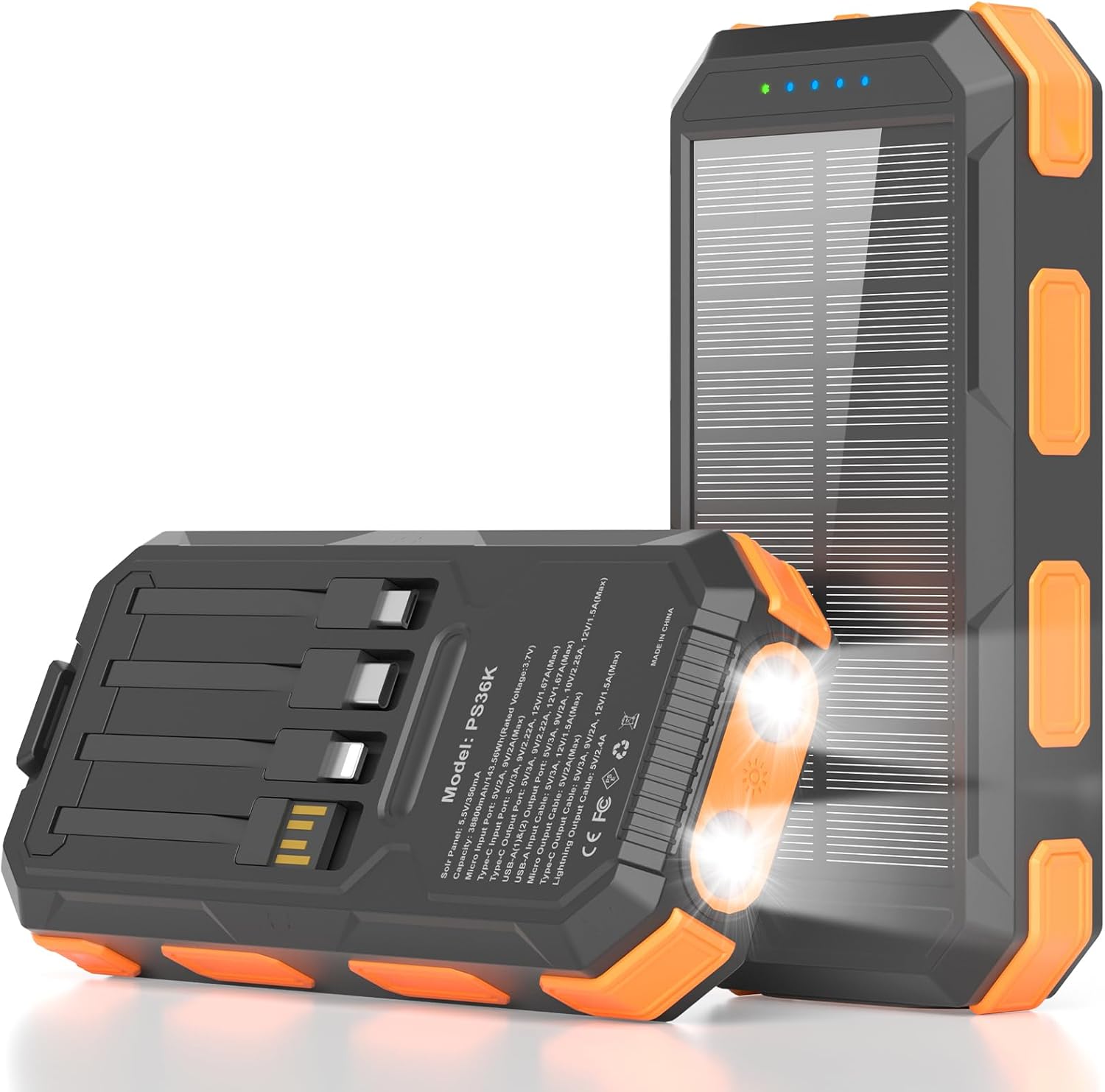
Pros
- Huge 38800mAh battery capacity provides multiple full charges for most smartphones (e.g., 6-7 charges for an iPhone 15).
- Built-in cables eliminate the need to carry separate charging cords – a huge convenience for travel and outdoor gear.
- Rugged IP65 construction and silicone bumpers withstand rain, dust, and drops, ideal for camping, hiking, and job sites.
- Dual flashlight with SOS mode adds practical emergency lighting without needing a separate headlamp or lantern.
Cons
- Solar charging is very slow – it only provides a trickle charge and requires direct sun for many hours (best used as a backup recharging method).
- Weight of 1.1 pounds is a bit heavy for ultralight backpacking, but manageable for camping or car travel.
- No wireless charging pad or higher-wattage USB-C PD (limited to 22.5W), so laptops may not charge efficiently.
The YELOMIN Solar Power Bank is a portable battery pack designed to keep your devices powered during outdoor trips, emergencies, or daily commutes. With a large 38800mAh capacity, it stores enough energy to charge a smartphone several times or a tablet at least once. This makes it a practical choice for campers, RV owners, hikers, and anyone who spends time away from wall outlets.
This power bank is best suited for outdoor enthusiasts and emergency preppers who need a reliable backup power source. Its IP65 waterproof rating and shockproof silicone corners allow it to handle rain, dust, and accidental drops – common challenges when camping, tailgating, or working on a construction site. The built-in 1.8W dual flashlight with SOS mode adds extra safety for night-time activities or power outage situations.
In terms of performance, the battery delivers up to 22.5W fast charging via the USB-C port, which can quickly replenish modern smartphones and tablets. The built-in cables (Type-C, iOS, and Micro USB) mean you don't need to dig around for cords – just plug and charge. Three additional output ports let you charge up to six devices at once, which is handy for families or group trips. Note that solar charging is a trickle process: it works in direct sunlight but will take many hours to fully recharge the 38800mAh pack. The product description correctly warns that solar should be seen as an emergency or supplementary charging method, not a primary one.
Build quality is solid for the price. The ABS and silicone construction feels durable, and the port covers keep debris out. The power bank includes overcharge, short circuit, and temperature protection, which helps safeguard both the battery and your devices. The included lanyard makes it easy to hang from a backpack or tent hook during use.
Storage and maintenance are simple – just keep it partially charged when not in use and recharge it every few months to maintain battery health. The unit measures 6.3 x 3.07 x 1.38 inches and weighs 1.1 pounds, so it fits easily in a daypack or car console without being too bulky.
Some realistic limitations include the slow solar recharging and the lack of high-wattage USB-C for laptops. The weight may also be noticed by ultralight backpackers. However, for most campers, road trippers, tailgaters, and emergency preppers, this solar power bank offers a dependable, versatile power solution at a reasonable price. If you need a long-lasting backup for phones, headphones, and small USB gadgets, the YELOMIN is worth considering.
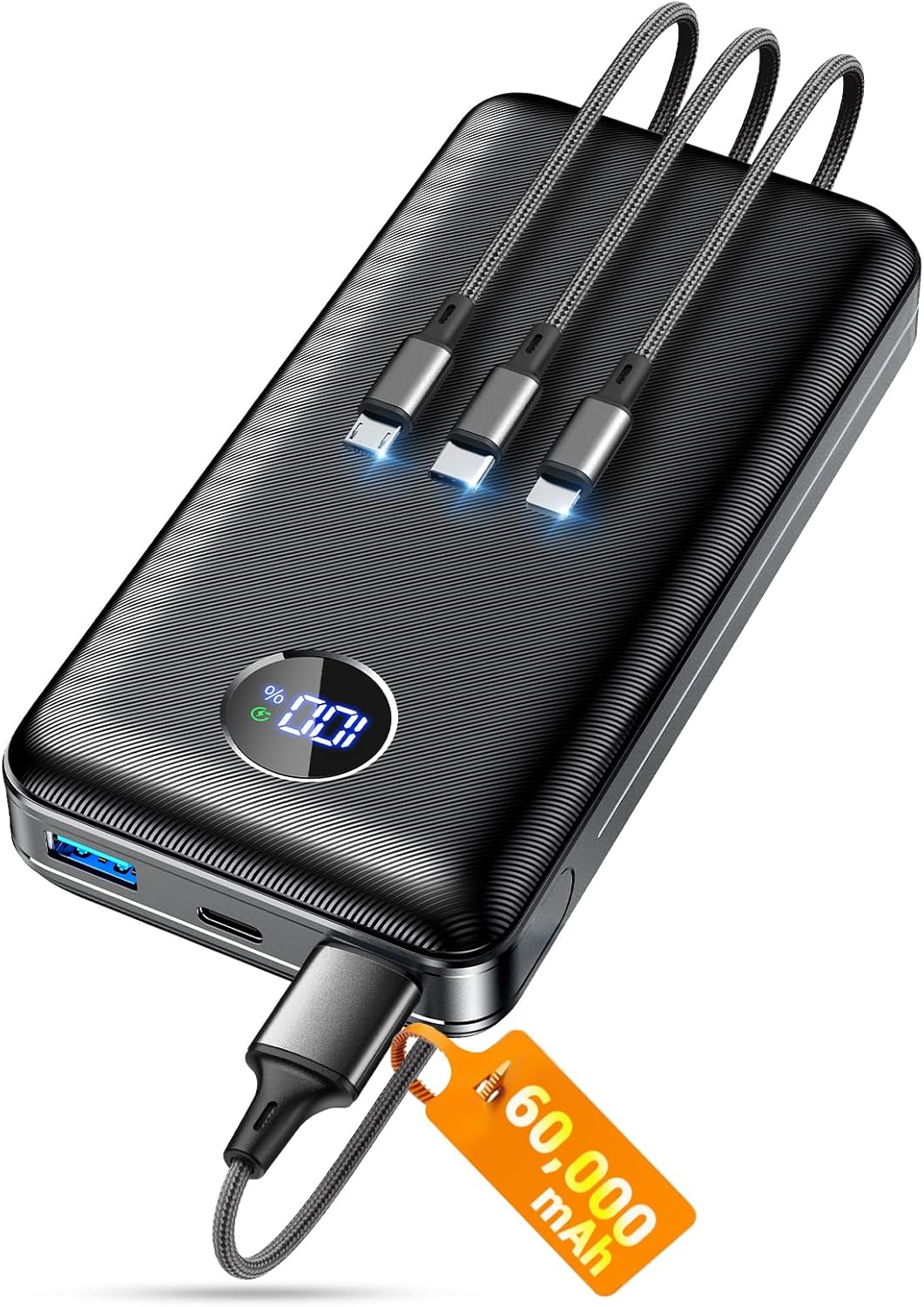
Pros
- Massive 60000mAh capacity provides multiple full charges for phones and tablets, ideal for multi-day camping trips or long road trips.
- 22.5W fast charging delivers quick power top-ups, charging an iPhone 15 to 60% in just 30 minutes.
- Built-in 3-in-1 cable (USB-C, iOS, Micro-USB) eliminates the need to carry separate cords, and the nylon braiding adds durability.
- Compact and lightweight design (15.5 oz) makes it easy to carry in a backpack, purse, or glove compartment.
- Clear LED digital display shows remaining battery level at a glance, so you always know how much power is left.
Cons
- At 60000mAh, this power bank exceeds the FAA limit for carry-on luggage, so it cannot be taken on airplanes, which may be a limitation for frequent flyers.
- Some users may find the included instructions for initial charging a bit unclear, though the device works well once set up.
- The power bank is slightly thicker than a typical phone, which might feel bulky in a pocket, but it's still compact for its capacity.
The ZZI 60000mAh Portable Charger Power Bank is a high-capacity lithium-ion battery pack designed to keep your devices charged during camping trips, road trips, tailgating, or everyday use. With a massive 60,000mAh capacity, it can fully charge an iPhone 15 up to 10 times, making it a reliable power source for multi-day outdoor adventures or emergency situations. The built-in 3-in-1 cable (USB-C, iOS, Micro-USB) adds convenience, so you don't have to carry multiple cords.
This power bank is best suited for campers, RV owners, road trippers, tailgaters, emergency preppers, and anyone who spends extended time away from wall outlets. It's also a great choice for remote workers, students, and parents on the go who need a dependable backup battery for their devices. The 22.5W fast charging capability means you can quickly top off an iPhone 15 to 60% in just 30 minutes, which is especially handy during a quick break on a road trip or between meetings.
In terms of real-world performance, the 60000mAh capacity can charge an iPhone 15 about 10 times, a Samsung Galaxy S24 around 7 times, or an iPad mini roughly 3 times. The power bank supports charging up to five devices simultaneously via its USB-A and USB-C ports, plus the built-in 3-in-1 cable. The 22.5W output via USB-C PD ensures fast charging for compatible devices, while the smart recognition chip adjusts power delivery to protect your device's battery. The LED digital display provides accurate real-time battery level, so you always know how much charge remains.
Build quality is solid, with a high-density polymer battery and a durable nylon braided 3-in-1 cable that has passed over 10,000 folding tests. The power bank itself features 5-layer safety protection, including overcharge, overcurrent, overdischarge, overvoltage, and short-circuit protection, along with smart temperature control. The compact dimensions (5.8 x 2.9 x 1.1 inches) and lightweight design (15.5 oz) make it easy to toss into a backpack, glove compartment, or camping gear. The LED digital display is clear and accurate, so you always know the remaining battery level.
Setting up and using the ZZI power bank is straightforward: just charge it fully via the USB-C input, then connect your devices using the built-in cable or additional ports. The 3-in-1 cable is a nice touch, as it covers the three most common charging standards, reducing cable clutter. Maintenance is minimal, and the 5-layer safety protection ensures worry-free operation. One realistic limitation is that the 60000mAh capacity exceeds FAA limits for carry-on luggage, so it's not suitable for air travel. Additionally, some users may find the initial charging instructions a bit sparse, but the device works well once set up.
Overall, the ZZI 60000mAh Portable Charger Power Bank offers excellent value for anyone needing a high-capacity, fast-charging power bank for camping, road trips, tailgating, or emergency preparedness. Its compact size, built-in cable, and clear LED display make it a practical choice for keeping multiple devices charged without the bulk. While it's not allowed on airplanes, it's a solid investment for ground-based adventures and daily use.

Pros
- Exceptional 50800mAh capacity provides multiple full charges for most phones, reducing battery anxiety during long trips.
- Built-in cables for iPhone, Type-C, and Micro USB mean you never have to remember extra cords, enhancing convenience.
- Fast charging at 25W PD and QC4.0 quickly powers up compatible devices, saving valuable time.
- LCD display clearly shows remaining battery level, helping you plan charging needs effectively.
- Can charge up to six devices simultaneously, perfect for families or group outings.
Cons
- At 1.2 pounds, it is slightly heavier than some smaller capacity power banks, which may be a consideration for ultralight backpackers.
- Built-in cables are fixed length and may not reach all devices comfortably in every setup.
- Recharging the power bank itself takes several hours due to its large capacity, though dual input options help.
The AONIMI 50800mAh Portable Charger is a high-capacity power bank designed to keep your essential devices running for days. With three built-in cables (Type-C, iPhone, and Micro USB) and three additional USB ports, it offers a true all-in-one charging solution for campers, RV owners, road trippers, emergency preppers, remote workers, van lifers, tailgaters, students, travelers, and parents on the go. Its massive 50800mAh battery can charge most smartphones over ten times, making it ideal for extended outdoor adventures, power outages, or long road trips where access to wall outlets is limited.
In terms of performance, this power bank delivers dual 25W PD and QC4.0 fast charging, which can refuel an iPhone 16 to 50% in just 30 minutes. It supports multiple charging protocols including PD3.0, QC3.0, QC4.0, DCP, FCP, and AFC, ensuring broad compatibility with iPhones (including the latest iPhone 17 series), Samsung Galaxy, Google Pixel, LG, tablets, Bluetooth headphones, and other USB-powered devices. The six output ports allow you to charge up to six devices at the same time, which is a huge plus for families or groups sharing a single power source during camping trips or tailgating events.
Build quality is solid with a compact form factor measuring 6.02 x 2.76 x 1.69 inches and weighing just 1.2 pounds. The unit features an intuitive LCD display that accurately shows remaining battery percentage, so you are never caught off guard. Safety is a priority with multi-layer protection including overcharge, over-discharge, short circuit, and high-temperature safeguards, plus a low-temperature ice core to prevent overheating. The power bank also supports pass-through charging, allowing you to charge the bank and your devices simultaneously, which is convenient for overnight use.
Ease of use is straightforward: simply plug in your device using one of the built-in cables or USB ports, and the power bank automatically detects and delivers the optimal charge speed. The built-in cables are a game-changer for travel, as they eliminate the need to carry separate cords, though their fixed length may require you to position the bank close to your device. Storage is simple, and the included USB-C cable makes recharging the bank itself easy via a wall adapter or laptop.
Realistically, the large 50800mAh capacity means the power bank takes several hours to fully recharge, but the dual input options (Type-C and USB-C) help speed up the process. Some users may find the weight slightly higher than smaller capacity banks, but the trade-off is significantly more power. It is not designed for heavy-duty use like powering laptops or small appliances, but it excels at keeping phones, tablets, and other small electronics charged during multi-day trips or emergencies.
Overall, the AONIMI 50800mAh Portable Charger is a reliable and versatile power bank that offers exceptional value for anyone needing dependable backup power. It is particularly well-suited for campers, RV owners, road trippers, emergency preppers, and families who want a single, all-in-one charging solution without the hassle of carrying multiple cables. For its capacity, fast charging, and built-in convenience, it is a solid choice for staying powered up during any adventure or daily commute.

Pros
- Exceptional 50000mAh capacity provides days of power for multiple devices, ideal for extended camping and emergency prep.
- Built-in cables for Lightning, USB-C, and Micro USB mean you never need to carry extra cords.
- Fast 22.5W charging dramatically reduces downtime compared to standard power banks.
- Sturdy build quality with durable cables rated for over 10,000 bends, plus comprehensive safety protections.
Cons
- Weighs 1.07 lb and is larger than typical pocket power banks, better suited for backpacks or emergency kits than daily pockets.
- Recharging the power bank itself takes several hours due to its high capacity, so plan ahead for overnight charging.
The OHOVIV Portable Charger Power Bank 50000mAh is a high-capacity lithium-ion battery pack designed to keep your devices powered during camping trips, RV adventures, road trips, tailgating, and emergency situations. With a massive 50000mAh capacity, it can recharge a modern smartphone up to 10 times, making it a reliable companion for off-grid living, power outages, or long travel days where wall outlets are scarce.
This power bank is best suited for campers, RV owners, outdoor enthusiasts, road trippers, emergency preppers, homeowners, remote workers, van lifers, tailgaters, students, travelers, and parents on-the-go. Its 22.5W PD and QC4.0 fast charging technology delivers rapid power to compatible devices, charging an iPhone to 55% in just 30 minutes. The built-in Lightning, USB-C, Micro USB, and USB-A cables eliminate the need to carry extra cords, and with 3 additional ports (2 USB-A, 1 USB-C), you can charge up to 6 devices at once.
Build quality is solid, with durable cables rated for over 10,000 bends and a compact form factor measuring 5.82 x 2.83 x 1.18 inches and weighing 1.07 lb. The LED digital display shows remaining battery level, helping you manage power usage. Safety features include 10-layer protection with an AI smart chip and NTC temperature control that reduces overheating risk by 97%, along with overcharge, short circuit, and surge protection.
In real-world use, the 50000mAh capacity supports multiple full charges for smartphones, tablets, headphones, and other USB devices, making it ideal for weekend camping trips, cross-country road trips, hurricane season prep, or powering devices at kids' sports events. The built-in cables are especially convenient for quick access, though the power bank itself takes several hours to fully recharge, so it's best to charge it overnight before a trip.
One limitation is its weight and size; at over 1 lb, it's not a pocket-friendly device for daily carry, but it fits easily in a backpack or emergency kit. Some users note that it's better suited for dedicated use during power outages or outdoor adventures rather than everyday pocket use. The included USB-C cable and user manual are helpful, but a wall charger block is not included, so you'll need your own.
Overall, the OHOVIV 50000mAh power bank offers exceptional battery capacity, fast charging, and built-in cable convenience at a reasonable price point. It's a practical choice for anyone who needs reliable portable power for camping, RV life, emergency backup, or travel. If you prioritize massive capacity and multi-device charging over pocket portability, this power bank is well worth considering.

Pros
- Docking station keeps all three power banks fully charged and organized, eliminating dead batteries and lost cables.
- Built-in USB-C and iOS cables mean you don't need to carry extra cords - just grab a bank and go.
- Ultra-portable size and weight make it easy to carry in a pocket or small bag for everyday use or travel.
- 180 included stickers allow for fun customization, making it easy for each family member to identify their bank.
- Charging dock charges all three banks simultaneously, so they're always ready when you need them.
Cons
- Charging speed is relatively slow; some users report it takes a while to fully charge devices, especially larger phones.
- Each power bank may only charge a modern smartphone to about 80% before depleting, so you may need to swap banks for a full charge.
- No display showing remaining battery percentage on the power bank itself - only a simple LED indicator.
If you're tired of fighting over wall chargers or hunting for a cable every time someone's phone dies, the GOODaaa 3-pack portable charger with docking station might be exactly what your household needs. This isn't just a single power bank - it's a whole system designed to keep three 10000mAh batteries fully charged and ready to go at all times. The central dock charges all three banks simultaneously, so you never have to remember to plug in each one individually. Just grab a fully charged bank on your way out, and drop the used one back in when you return. It's a simple, practical solution for families, roommates, or small offices.
Each power bank is impressively slim and lightweight - just 4.3 inches tall, 2.6 inches wide, and 0.7 inches thick, weighing only 6.42 ounces. That makes it easy to slip into a jeans pocket, purse, or backpack without adding noticeable bulk. The built-in USB-C and iOS cables are a huge convenience, meaning you don't need to carry separate cords. Plus, there's an extra USB-C port on each bank, so you can charge two devices at once per bank. With all three banks in use, you can charge up to nine devices simultaneously - perfect for a family road trip, a day at the beach, or keeping everyone's devices powered during a power outage.
The included 180 DIY stickers add a fun, personal touch. With multiple themes and high-quality patterns, each family member can customize their own power bank, making it easy to tell them apart. The stickers are applied to the blank side of the bank, and the process is simple enough for kids to enjoy. This feature also makes the set a great gift for families or groups who want to avoid mix-ups.
In terms of performance, each 10000mAh power bank can provide around 80% charge to a modern smartphone like the iPhone 17 Pro Max, according to user feedback. Charging speed is on the slower side, so it's best suited for topping off devices overnight or during extended periods away from a wall outlet. The smart chip inside protects against overcharging, short circuits, and overheating, giving you peace of mind. The dock's LED indicators show when each bank is fully charged (steady glow) or still charging (dim glow), and when a bank's own battery is depleted, a blue light flashes.
Build quality feels solid for the price point. The dock has a small footprint (6.69 x 3.82 x 5.28 inches) and weighs about 2.53 pounds total with all banks inside. It's designed to sit on a shelf, desk, or countertop without taking up too much space. The charging dock is only compatible with the included GOODaaa power banks, so you can't mix and match with other brands - a limitation to keep in mind. The set comes with a USB-A to USB-C cable and a USB-A adapter, so you can power the dock from any standard USB wall charger.
Overall, the GOODaaa 3-pack portable charger with docking station is a smart choice for families, small offices, or anyone who wants a tidy, always-ready charging solution. It's especially useful for households with multiple devices, for travel where outlets are scarce, or as an emergency backup during power outages. While charging speed isn't the fastest and each bank won't fully charge a large phone, the convenience of having three fully charged banks always at hand more than makes up for it. If you value organization and simplicity over raw speed, this kit is a solid investment.

Pros
- Extremely portable and pocket-friendly design, perfect for on-the-go use.
- Built-in USB-C connector eliminates the need to carry a separate cable for charging.
- PD fast charging support ensures quick top-ups for both the power bank and your phone.
- Smart LCD display gives clear battery status at a glance.
- Pass-through charging adds convenience when you're near an outlet.
Cons
- 5000mAh capacity is limited to a single full charge for most phones, so not suitable for extended trips without recharging the power bank.
- Not compatible with Lightning port iPhones (iPhone 14 and earlier) – only works with USB-C devices.
- Phone case thickness must be less than 4mm for direct plug-in; thicker cases need to be removed.
This HETP mini portable charger is a compact power bank designed for USB-C devices. It's tailored for anyone who needs a lightweight emergency backup when they're out and about – whether you're camping, tailgating, commuting, or just running errands. With its built-in USB-C connector, you can plug it directly into compatible phones like the iPhone 15, 16, 17 series and many Android models without fumbling for a cable.
For campers and outdoor enthusiasts, the 5000mAh capacity is enough to give your phone a full recharge, keeping you connected for navigation or emergencies. The tiny size (3.2 x 1.96 x 1 inches) and weight of only 0.22 lb mean it disappears into a pocket or small bag. The smart LCD display shows the remaining battery level, so you're not caught off guard. It also supports pass-through charging, so you can charge the power bank and your phone at the same time when you're near a wall outlet.
Build quality is practical for daily use, with a plastic housing that feels sturdy enough for pocket carry. The built-in USB-C connector is a clever design, but it means the power bank is only useful for USB-C devices – not for older iPhones or devices with Lightning or micro-USB ports. The product description recommends removing phone cases thicker than 4mm for a proper connection. That's a minor hassle but manageable.
In terms of performance, the PD fast charging feature recharges the power bank itself in about 2-3 hours, which is reasonable. The output is sufficient for standard phone charging speeds. While it's not a high-capacity battery for multiple charges, it's perfect as a daily emergency backup or for short outings. Students, travelers, and parents on the go will appreciate the convenience of a no-cable solution.
One limitation is that the 5000mAh capacity won't fully recharge larger devices like tablets or multiple phones. It's strictly a phone-focused power bank. Also, it's not compatible with iPhone 14 or earlier models because they use Lightning. If you're in the USB-C ecosystem, though, this is a very handy little charger.
Overall, the HETP mini power bank earns a solid recommendation for anyone wanting a super portable, no-fuss backup for their USB-C phone. It's not a heavy-duty power station for extended off-grid use, but it nails the convenience factor for daily life and travel. If you value pocketability and simplicity, this is a great little gadget to keep in your bag.

Pros
- Enormous 70000mAh capacity easily lasts a week for moderate users, great for multi-day trips.
- Fast charging (30W) works well with iPhones and Android phones, cutting recharge time significantly.
- Solid build with integrated lanyard and accurate LED battery display.
- Versatile compatibility with most 5V USB devices including phones, tablets, gaming consoles, and heated gear.
Cons
- Heavy at 1.85 lbs—not ideal for ultralight backpacking or pocket carry.
- Not allowed on airplanes due to capacity (259Wh exceeds TSA limit).
- Some users report actual capacity may be slightly lower than advertised, though still high for real-world use.
The Liahomco 70000mAh Portable Charger is a high-capacity power bank designed for users who need serious battery backup away from outlets. It’s built for campers, RV owners, road trippers, emergency preppers, tailgaters, and anyone who relies heavily on their devices during extended outdoor activities or power outages. This external battery pack can charge smartphones 15-20 times or tablets 5-8 times on a single charge, making it a reliable companion for week-long trips.
In real-world use, the 30W USB-C PD and QC 3.0 fast charging is a standout feature. It can bring an iPhone from empty to 60% in about 30 minutes, as long as your cable and device support fast charging. The unit includes five output ports (two 30W USB-A, two 15W USB-A, and one 20W USB-C) plus two input options (USB-C and Micro USB), so you can charge up to five devices at once. The LED display is accurate and easy to read, letting you plan your charging needs without surprises.
Build quality feels solid with a compact footprint (5.7 x 2.7 x 2 inches) and a weight of 1.85 pounds. While it’s not pocket-friendly, the included lanyard allows you to hang it from a backpack, tent hook, or belt loop. The lithium-polymer battery pack includes multiple safety protections against overcharging, overheating, and short circuits. It also works well with 5V USB-powered gear like handheld fans, heated jackets, Bluetooth speakers, and camera batteries—adding versatility beyond just phones and tablets.
One realistic limitation is the weight: at nearly two pounds, it’s better suited for car camping, RV use, or base camps than for ultralight backpacking. Also, the 70000mAh (259Wh) capacity disqualifies it from air travel, so it’s strictly a ground-based companion. Some customer feedback suggests the actual usable capacity may be slightly under the advertised figure (around 180-190Wh in tests), but for most outdoor and emergency needs, that still provides ample power for several days.
Setup is straightforward: charge it fully using the included USB-C cable (or a wall charger), then plug in your devices. For first-time use, the manual suggests a full drain and recharge cycle to calibrate the battery gauge. Maintenance is minimal—store it in a cool, dry place and top it up every few months if not in use. The package includes the power bank and a user manual; no wall adapter is included, but any standard USB-A or USB-C charger will work.
Overall, the Liahomco 70000mAh power bank is a solid investment for campers, RVers, preppers, and road trippers who prioritize capacity over portability. It’s not a pocket-sized daily charger, but for multi-day off-grid stays or emergency backup at home, its massive battery and fast charging make it a practical choice. If you need a beefy power bank for your next camping trip or hurricane season prep, this one delivers reliable juice at a reasonable price point.

Pros
- Ultra-slim and lightweight design makes it easy to carry anywhere, from hiking trails to daily commutes.
- Two-pack value provides ample power for multiple devices or shared use with family and friends.
- USB-C output and input offers modern compatibility and faster recharging of the power bank itself.
- Auto-detect and auto-shutoff simplify use – just plug in a device and it starts charging automatically.
Cons
- Cannot charge devices while the power bank is being recharged (no pass-through charging), which may be inconvenient for some users.
- Some users report a gradual decline in capacity over several months, potentially reducing long-term reliability.
- Maximum output of 12W per port is slower than fast-charging standards like Qualcomm Quick Charge or USB-C PD, so larger devices may charge more slowly.
The Miady 2-Pack 10000mAh Portable Charger is a reliable power bank solution designed for campers, RV owners, travelers, and emergency preppers who need compact backup power for smartphones, tablets, and other USB-powered devices. Each pack holds a 10,000mAh lithium-polymer battery, enough to fully recharge most smartphones two to three times. The slim profile (5.5 x 2.6 x 0.6 inches) and light weight (7.68 ounces) make it easy to toss into a backpack, glove compartment, or even a pocket, perfect for road trips, tailgating, or daily carry.
In terms of performance, each power bank features two USB-A ports and one USB-C port, all capable of delivering up to 5V/2.4A (12W max). This allows you to charge three devices simultaneously, such as an iPhone, Samsung Galaxy, and a pair of wireless earbuds. The USB-C port also serves as an input, letting you recharge the power bank itself in about five hours using a standard USB-C cable (included). Note that the bank cannot charge other devices while it is being recharged, which is a limitation for some users who need continuous power. The built-in LED indicators provide a simple way to check remaining battery level – each light represents 25% capacity.
Build quality is solid for the price point, with a durable plastic casing that feels sturdy enough for everyday use. The Li-polymer battery is safer than older Li-ion cells, and the power bank includes protections against overcharging, short circuits, and overheating. The auto-detect feature automatically starts charging when a device is connected and stops when it's removed, eliminating the need for manual on/off. Miady offers an 18-month warranty, which adds peace of mind for buyers concerned about long-term reliability.
Ease of use is straightforward: simply connect your device via USB-C, Micro-USB, or Lightning (cable not included), and the charging begins within seconds. The compact size means it won't weigh down your bag, making it a great companion for hiking, music festivals, or emergency kits. For campers and RV owners, it's a handy backup for keeping phones and tablets powered during off-grid stays, though it won't run larger devices like laptops or mini-fridges.
One realistic limitation is the charging speed. At 12W per port, it's slower than modern fast-charging standards like USB-C Power Delivery (18W+). Users with newer phones that support fast charging may find the recharge time a bit sluggish. Additionally, a few user reviews mention a gradual decline in capacity after several months of use, which could affect long-term value. However, given the affordable price and two-pack format, the Miady charger still offers good value for budget-conscious buyers who need reliable backup power without the bulk.
Overall, the Miady 2-Pack 10000mAh Portable Charger is a practical choice for anyone seeking a slim, lightweight power bank for everyday use, travel, or emergency preparedness. It's particularly well-suited for road trips, short camping excursions, and as a backup for power outages. While not the fastest or most durable option on the market, its combination of capacity, portability, and multiple ports makes it a solid entry-level purchase for students, parents on-the-go, and gift buyers looking for a useful present.
Evaluating Battery Cell Technologies in Portable Power Banks
Choosing the best power bank battery technology starts with understanding the trade-offs between cylindrical lithium-ion cells and lithium-polymer pouch cells. While cylindrical cells provide rigid structural defense and dependable thermal stability, flat lithium-polymer pouches offer exceptional versatility for ultra-slim everyday carry designs. The ideal selection depends on how you balance physical pocketability, energy density, sustained wattage delivery, and strict transportation regulations.
Lithium-Ion Cylindrical Cells Versus Lithium-Polymer Pouch Cells
Cylindrical lithium-ion cells, commonly manufactured in standard 18650 or 21700 sizes, rely on a rigid metallic casing surrounding a tightly wound cylindrical jelly roll of anode, cathode, and liquid electrolyte. This steel or aluminum exterior provides exceptional structural durability and resists physical compression or puncturing during transit. In contrast, lithium-polymer cells utilize a flexible aluminum laminated pouch containing a gel or porous separator saturated with electrolyte. The absence of a heavy metallic shell makes pouch cells substantially lighter and adaptable to virtually any rectangular dimensions.
Choosing between these two designs involves balancing rigidity against packaging flexibility. Cylindrical cells benefit from automated manufacturing precision, which yields highly uniform electrical characteristics across large production batches. Pouch cells allow manufacturers to build ultra-slim external battery packs that slide smoothly into pockets alongside a phone. However, the lack of an outer metal cylinder means polymer packs rely entirely on the outer plastic housing of the power bank for physical impact defense.
Gravimetric Energy Density and Physical Form Factor Considerations
Energy density determines how much electrical capacity a power bank stores relative to its physical size and mass. High-capacity 21700 cylindrical cells offer exceptional volumetric energy density, packing considerable energy into a compact cylinder. When engineers assemble multiple cylindrical cells together, however, the circular profiles inevitably leave empty gaps inside the enclosure. Lithium-polymer pouch cells eliminate these internal air spaces because rectangular slabs can be stacked flat against one another.
This geometric efficiency explains why everyday carry power banks measuring under an inch in thickness almost universally employ lithium-polymer construction. Multi-pack designs, such as pocket-friendly slim chargers and modular docking stations, maximize interior volume by using tailored polymer pouches. Massive high-capacity bricks often leverage dense lithium-polymer sheets to deliver multi-day power without expanding into awkward spherical dimensions. For users prioritizing minimalist pocket carry, flat polymer cells provide the most comfortable ergonomic profile.
Thermal Performance, Heat Dissipation, and Internal Resistance
Operating temperature directly impacts battery efficiency, safety, and longevity during heavy charging cycles. Cylindrical cells typically feature lower internal resistance thanks to robust internal current collectors and consistent electrode spacing. The cylindrical surface area also facilitates airflow and passive cooling when cells are spaced within a ventilated casing. Metal cans distribute localized hot spots evenly across their conductive shells, preventing isolated heat spikes.
Pouch cells face distinct thermal challenges because heat tends to accumulate in the core of stacked layers. If a power bank lacks adequate thermal dissipation materials, sustained high-output charging can elevate internal temperatures quickly. Excessive heat buildup in lithium-polymer packs can accelerate electrolyte breakdown and generate gas, resulting in visible pack swelling. Quality power banks counter this risk by integrating negative temperature coefficient thermistors and aluminum heat spreaders inside the chassis.
Cycle Life Longevity and Chemical Degradation Over Time
Both lithium-ion chemistries experience natural chemical degradation as lithium ions shuttle between the anode and cathode during charge and discharge cycles. Standard consumer power banks generally provide between 300 and 500 complete recharge cycles before maximum capacity drops below 80 percent of its original rating. Cylindrical cells often maintain mechanical electrode stability longer due to the uniform physical pressure exerted by the outer steel cylinder. This continuous pressure prevents the internal active materials from delaminating during repeated expansion and contraction.
Pouch cells expand and contract slightly during every charge cycle, which can cause micro-fissures in the electrode coating if mechanical tolerances are loose. Storing any lithium pack at 100 percent state of charge in a hot environment dramatically accelerates this degradation process. Discharging cells below their 3.0V safety floor can also cause permanent copper dissolution, leading to internal short circuits. Maintaining power banks between 20 percent and 80 percent charge when in storage optimizes chemical health across several years.
Nominal Voltage, Conversion Losses, and True Usable Watt-Hours
A universal source of confusion among buyers is the discrepancy between nominal cell capacity and delivered energy. Internal lithium cells operate at a nominal voltage of 3.7V, meaning a 10,000mAh battery pack contains 37 watt-hours of gross energy according to the standard formula multiplying milliamp-hours by 3.7V and dividing by 1,000. When charging a modern smartphone, the power bank must boost this 3.7V base voltage up to 5V, 9V, or higher. This DC-to-DC boost conversion naturally incurs energy loss through electrical resistance and heat dissipation.
Real-world power banks deliver an average efficiency baseline between 65 percent and 75 percent of their rated nominal capacity. A nominal 10,000mAh pack therefore yields roughly 6,500mAh to 7,500mAh at standard charging voltages to connected devices. High-capacity external batteries operating at 50,000mAh or 70,000mAh provide massive reserves for extended off-grid trips, but still follow these exact conversion principles. Calculating true usable watt-hours rather than relying purely on advertised milliamp-hours prevents false expectations during critical travel moments.
Fast Charging Protocols and Sustained Power Delivery Demands
Modern smartphones and mobile accessories demand sophisticated charging protocols to deliver high wattage safely. USB Power Delivery 3.0 and Qualcomm Quick Charge negotiate elevated voltages such as 9V, 12V, or 15V to transfer power without drawing excessive current through the cable. Programmable Power Supply protocol further refines this process by adjusting voltage in minute increments to minimize thermal buildup inside the phone. Buyers seeking portable chargers designed for smartphones frequently encounter these dynamic protocol standards.
Delivering 20W to 30W output requires the battery cells to discharge at elevated C-rates, increasing internal thermal stress. Both premium cylindrical cells and quality lithium-polymer pouches can handle these discharge rates when paired with appropriate power management microcontrollers. The input recharge speed of the power bank is equally critical, as high-capacity models require multi-watt USB-C inputs to replenish within hours rather than days. Pairing a large battery bank with an underpowered 5W wall adapter creates an extreme charging bottleneck.
Aviation Safety Regulations and Watt-Hour Legal Limits
Air travel introduces strict legal restrictions on carrying lithium battery packs aboard commercial aircraft. Under federal hazardous materials regulations outlined in 49 CFR 175.10(a)(18), all standalone power banks must travel exclusively in carry-on baggage. Placing lithium batteries in checked luggage is strictly prohibited worldwide due to the undetectable risk of cargo-hold fires. Furthermore, airport security checkpoints enforce an unrestricted capacity ceiling of 100 watt-hours per battery pack.
Converting milliamp-hours to watt-hours reveals why capacity selection is crucial for air passengers. A standard 20,000mAh power bank operates at 74 watt-hours, placing it safely beneath the federal 100 watt-hour threshold for unrestricted cabin travel. Conversely, massive 50,000mAh and 70,000mAh external battery packs exceed 185 to 259 watt-hours, making them illegal for commercial flights. Travelers must verify the printed watt-hour rating on the battery casing to prevent confiscation at security checkpoints.
Battery Management Systems, Thermal Sensors, and Safety Certifications
Regardless of whether a power bank uses cylindrical cans or flat polymer pouches, the internal Battery Management System acts as the primary safety barrier. The management board continuously monitors individual cell voltages to prevent overcharging past 4.2V and over-discharging below safe operational cutoffs. Embedded negative temperature coefficient thermistors track surface heat, immediately throttling power or cutting current if temperatures exceed safe parameters. Reputable devices also integrate current-limiting hardware to prevent catastrophic short circuits.
When examining magnetic portable chargers for mobile devices, effective thermal shielding becomes even more critical due to the induction heat generated by wireless coils. System-level certifications like UL 2056 and cell-level standards such as UL 1642 verify that the internal assembly withstands electrical and thermal stress. Independent certifications, including CE, FCC, and RoHS, confirm that the battery pack complies with rigorous electromagnetic and environmental safety requirements. Choosing certified hardware ensures that multiple redundant safety systems protect your connected equipment.
Application-Specific Cell Selection for Practical Daily Use
Determining which battery architecture serves you best depends largely on your intended mobility and daily usage patterns. Commuters who slip their power bank into a front jeans pocket or slim briefcase benefit most from compact lithium-polymer units. These thin packs offer ergonomic carrying comfort and integrate neatly with handheld phones without adding bulky weight. Modular multi-bank docking stations also utilize flat polymer packs to provide always-charged, grab-and-go convenience for busy households.
Field workers, campers, and emergency planners often prefer heavy-duty power banks engineered with high-density polymer cells or rugged cylindrical enclosures. Outdoor units encased in shockproof ABS shells with silicone port covers withstand moisture, dust, and physical impacts that delicate commuter packs cannot tolerate. Ultra-high capacity external batteries designed with integrated charging cables eliminate clutter when powering multiple phones and accessories simultaneously during power outages. Matching the physical footprint and cell construction to your typical environment ensures seamless power delivery.
Practical Maintenance Habits and Final Takeaway
Maintaining your power bank properly preserves usable capacity and extends its operational lifespan across years of regular duty. Never leave external battery packs exposed to direct sunlight on vehicle dashboards or trapped inside unventilated bags while fast charging. If you store a backup battery for seasonal emergency preparation, recharge it to roughly 50 percent capacity every three months. Routine visual inspection of the outer casing helps detect early signs of internal swelling or structural cracking.
The optimal power bank battery is not defined by a single chemistry, but by how well the design aligns with your personal portability and capacity requirements. Lithium-polymer pouch cells dominate slim everyday carry profiles where ergonomic convenience is paramount. Robust cylindrical cells and high-density polymer packs provide durable energy reserves for demanding multi-device workflows and remote off-grid trips. By considering watt-hour ratings, charging protocols, and safety protections, you can choose a dependable power bank that keeps your devices running reliably.




Write Your Review
No reviews yet. Be the first to share your experience!