

Watching your phone battery slip to single digits on a remote trail is an uneasy feeling, especially when navigation apps demand constant power. Off-grid travel quickly exposes which gear can handle shifting elements and which setups fail the moment shade rolls in. Pinpointing the best solar powered usb charger means weighing raw wattage generation against carry weight, whether you need a dedicated folding array or an integrated emergency battery pack. If you already travel with a dependable portable charger for travel, pairing it with high-efficiency monocrystalline solar cells keeps your mobile devices functional without searching for an electrical outlet.
Direct sunlight fluctuates constantly as the sun arcs across the sky or clouds drift overhead. Modern outdoor panels address this challenge with multi-port junctions, durable ETFE protective coatings, and smart IC chips that restore power delivery automatically after shadows clear. Based on product specifications and verified user feedback, distinct trade-offs exist between ultralight backpacking kits and high-capacity emergency reserves. Selecting the right setup comes down to your daily energy needs, pack space, and the specific device ports you must support on the trail.

Pros
- Ultra-light and compact design for easy portability on hikes or in go-bags
- Fast charging with both USB-A QC3.0 and USB-C PD for modern devices
- Durable IP67 construction resists rain, dust, and scratches for long outdoor life
Cons
- Requires direct sunlight for best performance; partial shade can reduce output significantly
- No built-in battery storage so it only works when the sun is shining
- DC port output limited to 40W max combined; charging two devices may slow each port
The FlexSolar 40W Foldable Solar Panel is a practical solar charger designed for outdoor enthusiasts who need to keep small electronics powered while away from wall outlets. It is a portable solar panel that converts sunlight into electricity, making it ideal for campers, hikers, backpackers, and emergency preppers who want to stay connected or keep devices running during off-grid adventures or power outages.
This panel is best suited for people who value lightweight gear and dependable charging on the move. At just 1.76 pounds and folding down to roughly the size of a small laptop, it slips easily into a backpack or emergency kit. With dual fast-charging outputs — a QC3.0 USB-A and a PD2.0 USB-C port, each capable of up to 18 watts — it can charge smartphones, tablets, power banks, and even some small GPS devices simultaneously. The 19V DC port adds versatility for powering compatible small solar generators directly.
According to product specs and user feedback, the monocrystalline cells achieve a 24% conversion efficiency, which is above average for panels in this class. That means it can charge a typical smartphone in a couple of hours under good sunlight. However, like all solar chargers, performance dips significantly in shade or cloudy conditions, so positioning is key. The included carabiners make it easy to attach to a tent, backpack, or tree. The IP67 waterproof rating and ETFE coating add peace of mind against rain, dust, and scratches during rugged use, though the junction box should be kept from heavy downpours.
Build quality feels solid for a foldable panel, with a durable fabric exterior and sturdy solar cells that resist wear. The smart IC chip automatically detects connected devices to optimize charging, and safety protections prevent overcurrent, overheating, and short circuits. There's no battery storage, so it works only when the sun shines, but it pairs well with a power bank for storing energy to use later. Some users note that charging one device at a time yields faster speeds than splitting power between two, which is a practical tip for efficient use.
While it's not meant to run large appliances or power a house, this panel excels at maintaining essential electronics for weekend campers, day hikers, or anyone building a lightweight emergency preparedness kit. Its portability and dependable solar conversion make it a smart choice for those who need a reliable trickle charger for phones, GPS units, or small power banks without adding much weight or bulk. For RV owners or van lifers who have more space and higher power needs, a larger panel might be more appropriate, but for backpacking or grab-and-go emergency use, the FlexSolar 40W is a well-rounded and practical solution.

Pros
- Lightweight and compact design makes it easy to carry on any outdoor adventure or store in an emergency bag.
- Multiple output ports (dual USB-C and USB-A) let you charge different devices at once, increasing efficiency.
- High solar conversion efficiency (25.4%) means you get more power from available sunlight compared to many competitors.
- Durable build with IP44 waterproof rating and polymer surface withstands outdoor elements and daily wear.
Cons
- Does not have a built-in battery, so it only charges devices when in direct sunlight and cannot store power for later use.
- Charging speed depends heavily on sunlight intensity and angle; performance drops significantly in cloudy or shaded conditions.
- Output limited to 5V/3A per port (12W max per port), which may be slow for larger power banks or devices that support faster charging.
The BigBlue 28W Solar Panel Charger is a portable solar charger designed to keep your essential electronics powered up when you are away from traditional outlets. It is best suited for campers, hikers, backpackers, RV owners, emergency preppers, outdoor enthusiasts, road trippers, van lifers, tailgaters, and anyone who spends time off-grid or wants a reliable backup power source for emergencies. This charger is also a practical gift for travelers, students, parents on-the-go, and homeowners preparing for power outages.
In real-world use, this solar panel delivers up to 28 watts of power from its high-efficiency solar cells, which convert 25.4% of sunlight into usable electricity. It features two USB-C ports and one USB-A port, each capable of outputting up to 5V/3A (12W), allowing you to charge multiple devices simultaneously like smartphones, power banks, GPS units, and headlamps. Keep in mind that actual charging speed depends on sunlight conditions; direct, bright sunlight yields the best results, while overcast skies or partial shade will slow charging significantly. The panel does not have a built-in battery, so it must be connected to your device while in the sun to charge.
Build quality is solid for a portable solar panel. The panels are made with advanced N-type solar cells and a shadow-free surface design that minimizes power loss from metal lines. The unit is rated IP44 waterproof, meaning it can withstand splashes and light rain, though the USB junction box is not fully waterproof and should be protected from direct water exposure. The foldable design is convenient: it folds to 11.1 x 6.3 x 1.34 inches and weighs just 1.48 pounds, making it easy to slip into a backpack or emergency kit. Four carabiners are included for attaching it to a backpack, tent, or other gear.
Ease of use is straightforward: simply unfold the panel in direct sunlight, connect your device via USB, and charging begins automatically. There are no buttons to press, and a blue LED light glows solid when charging properly. For best performance, keep the panel clean and free of shadows, and avoid using it behind glass windows, which can block up to 25% of sunlight. Some users find that propping the panel up with a stick or gear helps maintain an optimal angle toward the sun. The panel works well with power banks that draw low current, but some larger power banks may require a minimum current that the panel might not always provide under weaker sunlight.
One realistic limitation is that the charger relies entirely on sunlight; it cannot charge at night or in very low light. Also, each USB port is limited to 12W, which is fine for phones and small devices but may be slow for larger power banks or tablets. The panel's output is also affected by temperature, angle, and shadows, so patience is required. For longer trips, many users pair this panel with a power bank to store energy during the day and charge devices later. The included USB-C to USB-C cable is a nice addition, but Apple device owners will need their own Lightning cable.
Overall, the BigBlue 28W Solar Panel Charger is a reliable and portable solution for keeping small electronics charged during outdoor adventures or emergencies. It is not a fast charger, but it offers dependable off-grid power when you need it most. For campers, hikers, and preppers who want a lightweight, durable solar charger that can handle multiple devices, this is a solid choice that delivers good value for the price.

Pros
- Huge 49800mAh battery capacity charges multiple devices many times over.
- Fast charging (15W) works great for iPhones and Androids.
- Rugged IP67 waterproof and dustproof design survives outdoor conditions.
- Dual LED flashlight with multiple modes is bright and useful.
- Comes with carabiner for easy backpack attachment.
Cons
- Solar charging is very slow due to large capacity; best used as a backup or emergency feature only.
- Some users reported loose internal batteries, raising concerns about long-term durability.
- Heavier (1.06 lbs) than typical compact power banks, though expected for its capacity.
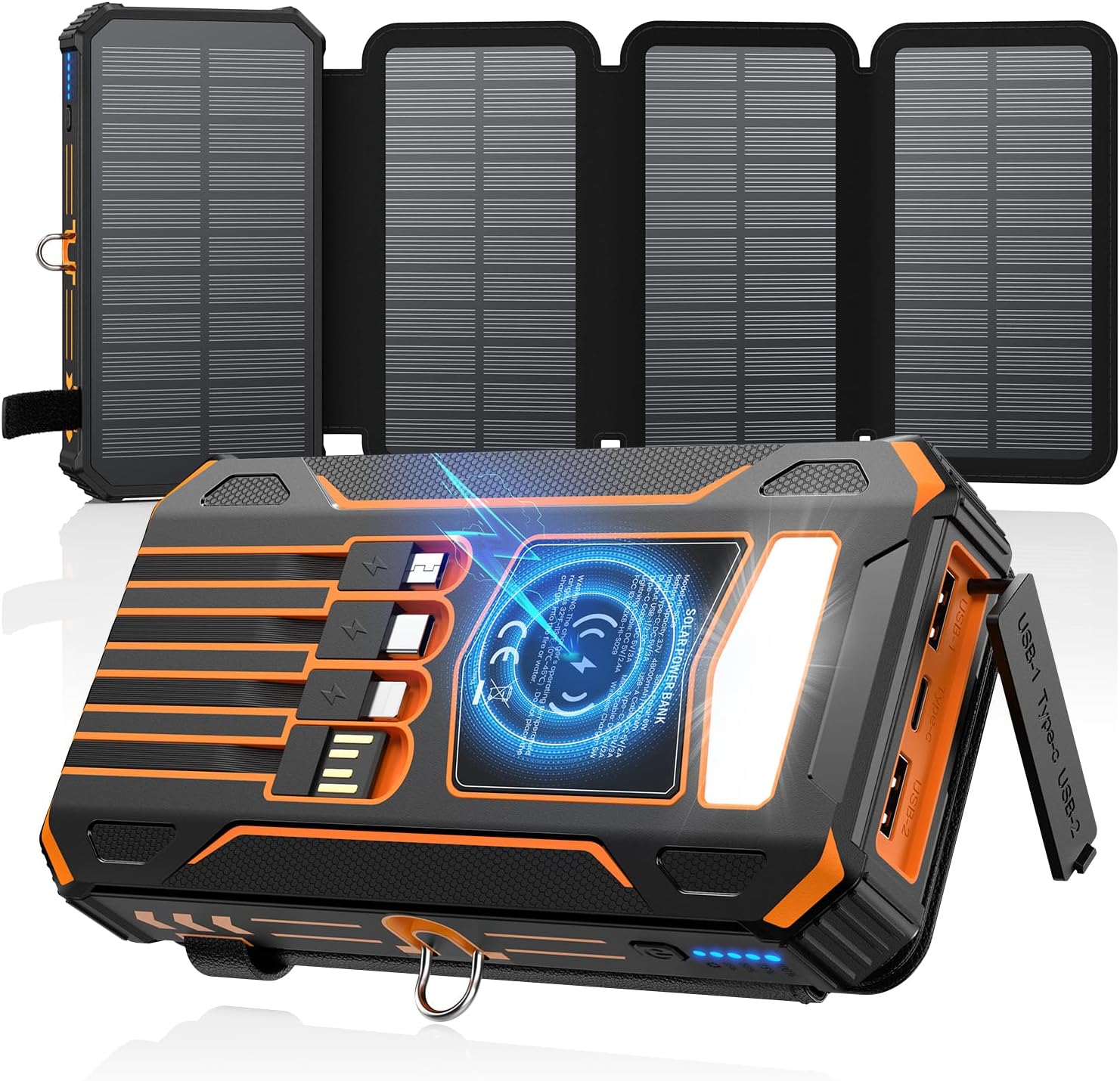
The Nuynix 49800mAh Solar Power Bank is a high-capacity portable charger designed for anyone who needs reliable power away from wall outlets. It is essentially a large lithium-ion battery pack with a built-in solar panel, two USB-A output ports, one USB-C port, and an LED flashlight. Intended for campers, hikers, road trippers, emergency preppers, and outdoor enthusiasts, this power bank aims to keep your essential gadgets running when you are off the grid.
With a massive 49,800mAh capacity, this power bank can charge a typical smartphone around 8-10 times or a tablet multiple times. According to user reviews, fast charging works well - one reviewer noted it charged an iPhone from 50% to 100% using only one battery bar. The 15W output is enough to quickly top off phones and smaller tablets. The three ports (2 USB-A + 1 USB-C) allow simultaneous charging of three devices, which is convenient for groups. The USB-C port can be used for both input and output, though it does not support Power Delivery at higher wattages. For daily charging, the product description recommends using a 5V/2A or higher wall charger, as built-in solar charging is slow due to the large battery and small panel.
The solar panel is clearly positioned as an emergency feature, not a primary charging method. User feedback confirms this: it trickle-charges the battery under direct sunlight, but it can take days to fully replenish. For hikers or backpackers, it provides a lifeline if you run out of power, but you should not rely on it for daily recharging. The IP67 waterproof rating means the device can be submerged in up to 1 meter of water for 30 minutes, making it resistant to rain, splashes, and accidental drops in puddles. Many reviewers praise its rugged build, noting it feels sturdy and durable for outdoor use.
Build quality receives mixed feedback. Most users find it solid and well-made, but one critical review mentions feeling loose batteries sliding inside the casing, which is a safety concern. The unit weighs 1.06 pounds and measures 7 x 3.4 x 1.2 inches - not as pocketable as smaller power banks but easy to toss in a backpack or attach with the included carabiner. The dual LED flashlight offers three modes (steady, SOS, strobe) and is surprisingly bright, adding value for camping or emergencies. The product includes a user manual and carabiner.
Ease of use is straightforward: charge the unit via microUSB (or USB-C with appropriate cable), then plug in your devices. It comes partially charged out of the box, as noted by some reviewers. Storage is simple - keep it in a dry place when not in use, and recharge every few months to maintain battery health. The smart protection IC chip provides overcharge, overcurrent, and short circuit protection, enhancing safety during use. However, given the one report of loose internal batteries, buyers should inspect their unit upon arrival. If any rattling is detected, contact customer support for replacement - one reviewer mentioned the company quickly replaced a lost unit, indicating responsive customer service.
Realistic limitations include slow solar charging, potential quality control issues (battery rattle), and the inability to power larger devices like laptops (no AC outlet). It also does not support pass-through charging (charging the power bank while it charges devices), as per typical power bank design. Some users with low-power devices (e.g., wireless driveway alarms) found the unit shuts off due to low current draw, so it is best suited for phones, tablets, and cameras. For its $27 price point, this power bank offers tremendous capacity and durability features that justify the cost. It is a great choice for budget-conscious campers, emergency preppers, and parents on the go who need reliable backup power for small electronics. If you need faster solar charging or laptop compatibility, consider larger solar generators, but for most USB devices, this is a practical and affordable solution.
Frequently Asked Questions
What is the difference between a folding solar panel and a solar power bank?
A folding solar panel generates live electricity directly from sunlight, whereas a solar power bank stores electricity inside an internal battery pack for later use. Foldable panels like the FlexSolar 40W Foldable Solar Panel Charger lack battery storage, meaning they only deliver current while resting in direct sun. In contrast, high-capacity models like the Solar Charger Power Bank 49800mAh prioritize stored reserves, using their built-in solar panel primarily for emergency top-offs. Understanding how many volts in a phone charger are required helps you choose between a direct 5V solar feed and an integrated battery bank.
Why do solar chargers deliver less wattage than their advertised rating?
Advertised wattage ratings reflect optimal laboratory test conditions that rarely occur during ordinary outdoor outings. Real-world solar irradiance, sun angle, air temperature, and atmospheric haze reduce actual charging wattage by twenty to thirty percent. Monocrystalline panels deliver peak efficiency when angled at approximately forty-five degrees facing direct midday sun. Any partial shadow falling across a single solar segment can temporarily lower overall output.
Can you charge a smartphone directly from a solar charger without damaging the battery?
Yes, quality solar panels feature intelligent voltage regulation chips that supply safe current to connected electronics. Units like the BigBlue 28W Solar Panel Charger with Dual USB-C stabilize output to standard 5V USB levels for phones, power banks, and GPS units. Keep your smartphone placed underneath the panel or shielded in an accessory pocket to prevent the device from overheating in full sun. High temperatures trigger thermal throttling in mobile operating systems, which restricts charging speeds to protect battery health.
How does auto-restart technology work on a Best Solar Powered Usb Charger?
Auto-restart technology automatically resumes charging handshakes with your phone once passing clouds or tree shadows move away. Basic solar arrays often freeze power delivery when sunlight drops momentarily, requiring a manual cable reconnect. Integrated smart IC chips monitor incoming solar irradiance and reset the connection without user intervention. This mechanism provides consistent charging while panels hang from a backpack or rest at basecamp.
Why is ETFE coating better than PET coating on portable solar panels?
ETFE laminate offers significantly higher heat tolerance, UV resistance, and abrasion defense than conventional PET plastic. Panels equipped with ETFE surfaces withstand rainfall, dust ingress, and prolonged sunlight exposure without clouding over time. PET coatings degrade faster in high-heat outdoor environments, which reduces solar light transmission. ETFE maintains superior surface clarity across years of rugged camping and emergency prep use.



Write Your Review
No reviews yet. Be the first to share your experience!