

Riding off into remote trails with an electric bike can turn stressful quickly when your battery gauge drops into the red miles away from civilization. Running out of juice on a steep fire road turns an enjoyable adventure into a grueling workout, leaving you stranded without motor assistance. Selecting the best ebike solar charger setup gives you true off-grid independence, keeping your battery bank topped up through long afternoons under direct sunlight. Instead of scrambling for wall outlets at crowded rest stops or packing an emergency portable charger for travel, having an efficient panel lets you harness daylight to extend your riding range.
Based on product specifications and user feedback, efficient power generation requires Grade A+ cells and smart controllers that adapt to shifting cloud shadows without stalling current flow. A dependable system pairs rugged, corrosion-resistant framing with smart circuitry that delivers constant energy without frying delicate electronics. Understanding basic electrical demands and how many volts in a phone charger or auxiliary battery helps you align wattage ratings with your pack requirements. Investing in reliable solar hardware secures true peace of mind on remote backcountry routes.
Frequently Asked Questions
Can you charge an ebike battery directly with a 12V solar maintainer?
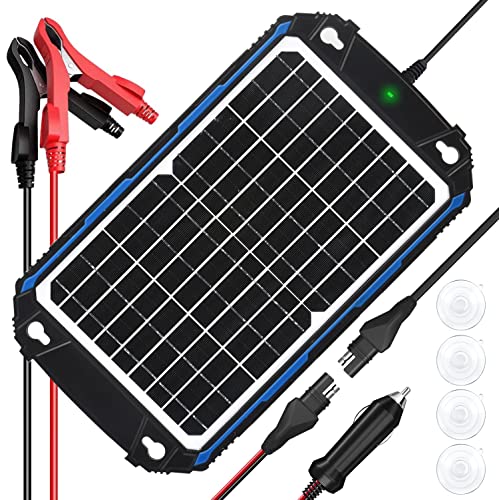
No, you cannot charge a standard 36V or 48V ebike battery directly with a single 12V solar panel without a step-up boost charge controller. A 12V panel like the SUNER POWER Waterproof 12W 12V Solar Battery is engineered specifically for 12V auxiliary batteries or small storage packs. Many riders connect compact panels to a 12V buffer battery first, then route power through a dedicated booster to charge their main drive pack safely.
How does MPPT technology improve solar charging efficiency?
MPPT technology actively tracks the optimal power voltage of the panel to deliver peak conversion efficiency up to 98%. Unlike basic regulators, smart controllers automatically adjust to fluctuating sunlight levels, squeezing out approximately 20% to 30% more usable power in overcast weather. This real-time tracking helps your best ebike solar charger setup gather maximum energy throughout shifting trail conditions.
Can solar panels withstand unexpected rain on the trail?
Yes, solar panels engineered with tempered glass surfaces and corrosion-resistant frames hold up well against sudden rainfall. High-grade units also feature spark-proof and waterproof wiring harnesses to prevent short circuits when splashed. While power generation declines significantly during heavy storms, the structural hardware remains completely protected against water ingress.
How long does a 12W solar panel take to replenish a battery?
A 12W panel operates as a trickle maintainer rather than a rapid charger, delivering under one amp of current per hour in full sun. It works best for counteracting natural battery discharge or gradually topping off auxiliary power banks during daytime rest stops. For situations involving drained secondary batteries, reviewing how to charge a car battery without a charger illustrates how steady low-amperage solar input prevents total battery failure.
What is the most effective way to mount a portable solar panel on a bike?
The simplest method involves securing the panel horizontally across a rear cargo rack or bike trailer using pre-drilled holes, suction mounts, or bungee straps. Laying the panel flat allows continuous daylight exposure while riding, though propping it toward the sun when parked yields much faster charging. If you need immediate supplemental energy during overnight stops, pairing your rig with a portable charger for car batteries or outdoor packs ensures you always have backup reserves.



Write Your Review
No reviews yet. Be the first to share your experience!