

Nothing drains morale faster on a remote trail than staring at a dead smartphone battery with miles left to hike. Sudden power outages or weekend backcountry trips require dependable off-grid power that won’t leave you stranded in the dark. That is where a detailed solar phone charger comparison helps you separate practical outdoor gear from gimmicky paperweights. While shopping for the best portable charger for travel often leads people to standard battery packs, solar-equipped units provide an emergency lifeline when wall outlets are completely out of reach.
Solar charging banks pair high-capacity lithium storage with integrated photovoltaic panels to capture sunlight during daylight hours. Manufacturers offer everything from lightweight pocket-sized units to rugged, high-capacity bricks with built-in multi-cables and wireless coils. Looking closely at port configurations, understanding how many volts in a phone charger connection you need, and evaluating realistic solar absorption rates ensures you get reliable wattage without carrying dead pack weight. Based on our detailed comparison of rated wattage, port configurations, and verified user feedback, here is how the top models stack up for your next outdoor excursion.


Pros
- Lightweight and pocket-friendly design makes it easy to carry on hikes, flights, or daily commutes
- 20W USB-C fast charging dramatically reduces charge time for modern smartphones and tablets
- Wireless charging pad adds convenience for Qi-compatible devices without extra cables
- Rugged IPX5 waterproof and shockproof build withstands outdoor conditions and accidental drops
- Dual LED flashlights with a compass carabiner provide practical emergency lighting and navigation
Cons
- Solar panel charging is extremely slow (works best only in direct sunlight) and serves mainly as an emergency backup
- 10,000mAh capacity may not fully charge larger devices like iPad Pro more than once, and capacity decreases with age
- No AC outlet or high-wattage output, so it cannot power laptops or larger electronics
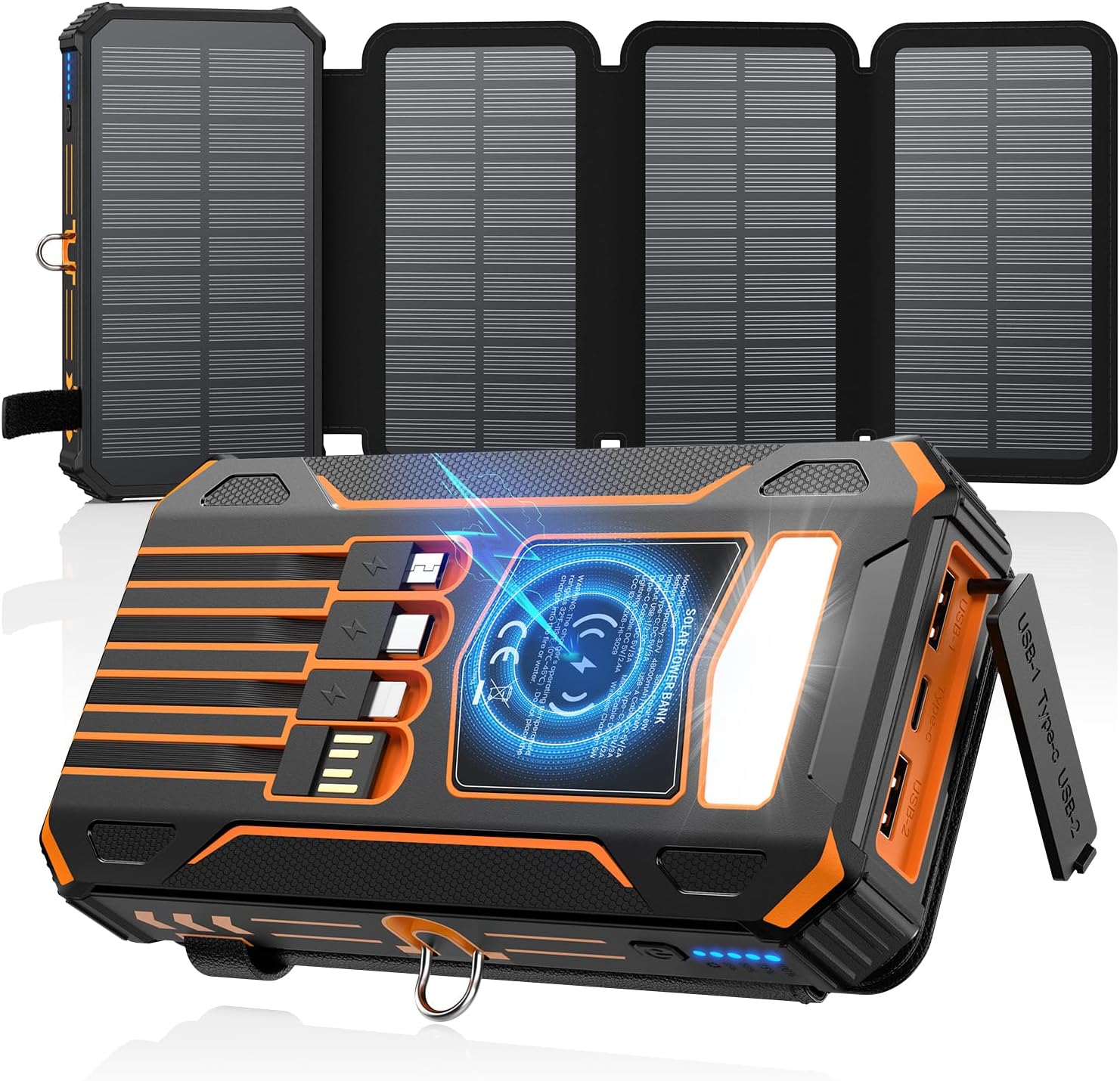
The BLAVOR Solar Power Bank is a compact 10,000mAh portable charger that combines USB-C fast charging, wireless Qi charging, and a built-in solar panel for off-grid power. It is designed for campers, hikers, road trippers, emergency preppers, and anyone who needs a reliable backup power source for their smartphone, tablet, or wireless earbuds while outdoors.
Target users include outdoor enthusiasts who want a lightweight, rugged power bank for weekend camping trips, day hikes, or beach outings. It also suits travelers, van lifers, and gift buyers looking for a practical white elephant present. Parents on-the-go may appreciate the dual flashlights for nighttime stargazing or emergency situations. Remote workers or students who need a quick top-up during a power outage will find the 20W USB-C fast charging valuable.
In terms of performance, the 10,000mAh Li-cobalt battery can charge an iPhone 14 Pro about 2.2 times or an iPad Air once. The 20W USB-C output can charge an iPhone 15 to 65% in 30 minutes. Wireless charging works for Qi-enabled phones at 10W max. The solar panel is small and primarily a backup feature; under bright sun it may trickle charge the internal battery but is not a primary charging method. The power bank can charge three devices at once via USB-A, USB-C, and the wireless pad. It does not include a wall charger, but a USB-C cable is provided.
Build quality is a highlight: the outer case uses flame-retardant ABS and PC materials, with a waterproof silicone layer inside. The rubberized skin-feel coating provides a comfortable grip and protects against drops. The IPX5 rating means it can withstand rain, splashes, and dust. Dual super-bright flashlights have a SOS mode and a compass carabiner adds safety. The battery management system protects against overcharge, short circuits, and temperature extremes.
Setup is straightforward: charge the power bank via USB-C (using a wall charger, not included) and it is ready to go. The flashlights are controlled by a single button. Storage and maintenance are simple, but note that solar charging should be used only as a last resort. A realistic limitation is that the 10,000mAh capacity is moderate; heavy users may need a larger power bank for multi-day trips. Also, solar charging is slow and impractical in cloudy weather.
Overall, the BLAVOR Solar Power Bank is a solid choice for anyone seeking a durable, compact, and fast-charging portable battery with emergency features. It works best as a daily carry for quick device top-ups, a lightweight camping companion, or a thoughtful gift for outdoor lovers. For serious off-grid needs, consider a larger solar generator, but for smartphone-level backup in a rugged package, this power bank may fit the bill.
The BLAVOR power bank features a 10,000mAh Li-cobalt battery, which offers about 50% more charge cycles than standard Li-polymer batteries. Based on typical usage, a full charge can provide approximately 3.6 full charges for an iPhone 8, 2.2 charges for an iPhone 14 Pro, or one charge for an iPad Air. The battery itself takes about 4-5 hours to fully charge via a 20W USB-C wall adapter (not included). Solar charging is much slower; under direct sun, it may take several days to fully recharge the bank. The battery management system helps maintain battery health and longevity.
Weighing only about 6.7 ounces and sized slightly smaller than a smartphone, the BLAVOR power bank is designed for pocketability. The rubberized skin coating provides a tactile grip and protects against scratches and drops. A built-in compass carabiner allows it to be clipped onto a backpack or belt loop. The dual LED flashlights are bright enough for walking at night or setting up camp. The overall design is sleek and utilitarian, fitting easily into a jacket pocket or small pouch.
Frequently Asked Questions
How long does it take to fully recharge a solar power bank using sunlight alone?
Several days of direct, unobstructed sunlight are typically required to recharge a solar power bank completely via its built-in solar cell. These compact integrated panels generate between 1W and 2W of power, making solar charging primarily an emergency backup rather than a primary replenishment method. For everyday adventures, wall charging provides the bulk capacity, while the solar panel preserves charge or offers critical emergency power during extended outages.
Can a solar phone charger power an iPhone or Android device directly?
Yes, solar power banks charge smartphones directly through their high-speed USB-C, USB-A, or wireless charging interfaces. High-efficiency models support fast outputs that rival standard portable chargers for iPhone 14 and modern Galaxy handsets. The internal lithium battery acts as a stable power reservoir, preventing voltage drops and smartphone overheating caused by fluctuating sunlight.
What is the main difference between a solar power bank and a folding solar panel?
A solar power bank stores energy directly inside a built-in battery, whereas a standalone folding solar panel generates live current without internal energy storage. Portable folding panels feature larger surface areas and higher wattage outputs, but they cannot hold electricity for nighttime use. In contrast, compact solar power banks collect power gradually and store it for whenever your mobile gear needs a quick boost.
Are solar phone chargers safe to use during heavy rain?
Most solar battery chargers feature IPX5 or IP65 weather-resistant ratings that protect against light rain splashes and trail dust, but they should never be submerged in water. Heavy silicone bumpers and sealed port covers shield internal circuits on durable adventure banks from sudden downpours. Keeping USB ports dry during use prevents electrical shorts and keeps delicate charging pins intact.
Does wireless solar charging work through thick phone cases?
Standard Qi wireless charging on solar power banks operates effectively through lightweight cases up to 3 to 5 millimeters thick. If you frequently use magnetic accessories, pairing your phone with a dedicated magnetic portable charger for Android or removing rugged metal-plated armor cases ensures optimal induction without energy loss. Direct cable connections via integrated USB-C cords remain the fastest off-grid charging route.
Can you charge a solar battery pack through a vehicle or home window?
No, modern glass windows filter out substantial ultraviolet and infrared spectrums, drastically reducing solar conversion efficiency. Placing a solar bank behind a car windshield also traps extreme heat inside the vehicle cabin, which can degrade sensitive lithium-polymer cells. Positioning your charger outdoors in direct, unshaded sunlight delivers the cleanest solar intake and prevents dangerous thermal buildup.



Write Your Review
No reviews yet. Be the first to share your experience!