

Watching your smartphone battery drain to zero on a remote backcountry trail can leave you completely disconnected. Wall outlets do not exist miles from camp, and standard battery bricks eventually deplete during extended excursions. That is where investing in the best portable solar charger with battery makes all the difference for your off-grid readiness. Instead of relying solely on pre-charged cells, you harness renewable sunlight to feed internal power reserves whenever daytime conditions allow. This setup provides dependable emergency juice without lugging heavy equipment into the woods.
Hardware specifications vary widely across the market, from compact everyday carry packs to multi-panel folding arrays. Many travelers rely on standard reliable travel power banks, but adding solar collection ensures long-term self-reliance. Modern designs incorporate high-efficiency cells, robust weatherproofing, and rapid USB-C Power Delivery to revive modern smartphones quickly. Packing a rugged solar battery pack keeps navigation apps, GPS beacons, and emergency communication gear running through any outdoor challenge.
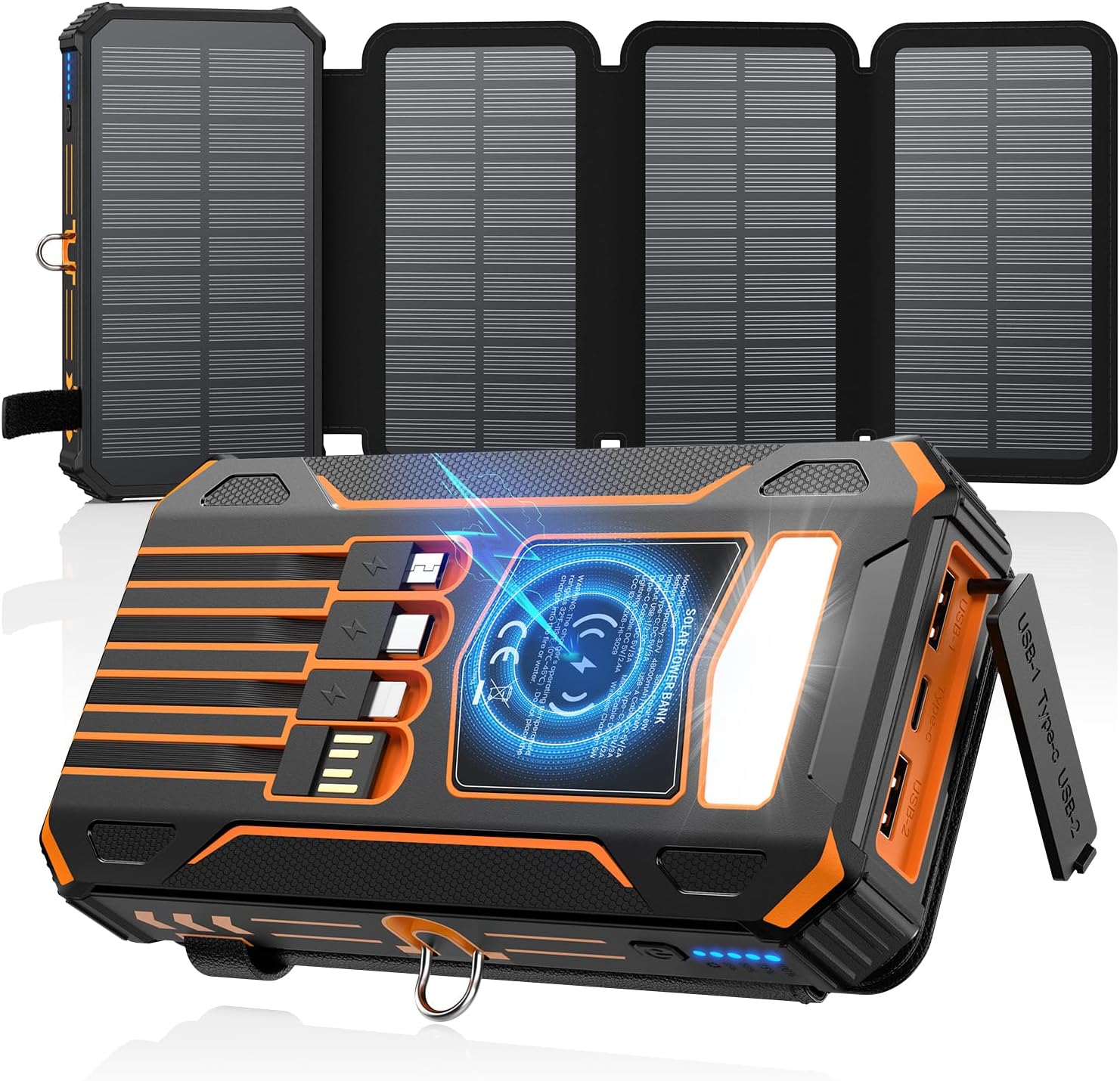
Pros
- Exceptional 48000mAh capacity for long trips
- Four built-in cables eliminate carrying separate cords
- Solar panels provide free renewable energy outdoors
- Wireless charging adds convenience for compatible phones
- Rugged, weather-resistant build handles rough use
Cons
- Solar charging speed depends on direct sunlight; may be slow on cloudy days
- No AC outlet; only USB and wireless outputs
- Weight of 1.5 pounds is reasonable but slightly heavier than basic power banks
The SOARAISE 48000mAh Solar Power Bank is a versatile portable charging solution designed for outdoor enthusiasts, campers, RV owners, and emergency preppers. Unlike standard power banks, it features four built-in solar panels that can harvest sunlight to recharge its massive battery, making it a reliable companion for off-grid adventures, power outages, or extended road trips. With a high-capacity lithium-polymer cell and multiple charging options, this unit aims to keep your devices powered without relying on wall outlets.
This power bank is best suited for campers spending days in the wilderness, RV boondockers needing backup power for phones and tablets, tailgaters who want to keep music playing, and homeowners preparing for storm-related outages. Remote workers, van lifers, and parents on-the-go will also appreciate the ability to charge several devices simultaneously. With its rugged, weather-resistant design, the SOARAISE can be tossed into a backpack, glove box, or emergency kit without worry.
According to the product specifications, the 48000mAh battery can recharge a typical smartphone six to eight times or a tablet two to three times. The four built-in cables (USB-C, iOS, USB-A, Micro) plus three USB ports and a wireless charging pad allow up to seven devices to charge at once, a huge convenience when traveling with family or sharing power. The 5V/3A USB-C port supports fast charging, and the wireless pad adds cable-free convenience for Qi-compatible phones. While there's no AC outlet, the multiple USB options cover most portable electronics.
Build quality is emphasized with waterproof, shockproof, and dustproof construction, plus a built-in LED flashlight for emergencies. The 1.5-pound weight and compact dimensions (6.38 x 3.43 x 1.57 inches) make it portable enough for everyday carry yet substantial enough to hold a large capacity. The integrated solar panels use monocrstalline cells for higher efficiency, though their output depends on direct sunlight. In sunny conditions, the four panels can replenish the battery faster than a single-panel charger, but cloudy days will extend recharge times significantly.
A few realistic limitations include the lack of an AC outlet, so you cannot power laptops or small appliances directly. Also, the solar charging is best used as a supplementary source rather than the primary recharging method; wall charging via the USB-C input is faster and more reliable. The orange color may not appeal to everyone, but it adds visibility outdoors. Some users may find the 1.5-pound weight slightly heavier than typical 20000mAh power banks, but the increased capacity and solar panels justify the trade-off.
Overall, the SOARAISE 48000mAh Solar Power Bank offers a well-rounded package for anyone needing off-grid power for multiple USB devices. It's a practical gift for outdoor lovers, a solid emergency backup for home, and a convenient travel companion. While it can't replace a full solar generator for heavy AC loads, it excels at keeping phones, tablets, cameras, and other USB gadgets juiced up anywhere. If you prioritize high capacity, built-in cables, and solar recharging in a durable form factor, this power bank is worth considering.
The SOARAISE power bank employs four monocrystalline solar panels that work together to harvest sunlight efficiently. According to the manufacturer, these panels charge up to five times faster than a single-panel design, which is a significant advantage when you're off the grid. However, keep in mind that solar charging speed varies with angle, cloud cover, and season. The panels can top off the internal battery over the course of a sunny day, making this unit a renewable power source for extended trips.
For charging devices, the power bank offers a wireless charging pad on top, plus three USB ports (two USB-A outputs and one USB-C input/output). Additionally, four cables are built right into the unit: USB-C, iOS, USB-A, and Micro-USB. This means you rarely need to dig for cords. The USB-C port supports 5V/3A input and output for fast charging, and the USB-A ports are standard 5V/2.4A. The wireless pad delivers standard Qi charging, compatible with iPhones and Galaxy models. You can charge up to seven devices at once, though total output is shared across the ports.
The SOARAISE solar power bank is built to handle the elements. The product description highlights its waterproof, shockproof, and dustproof design, meaning it can survive drops, rain, and dusty trails. The orange casing is rugged and textured for a secure grip, and the built-in flashlight with multiple modes (including SOS) is a handy feature for nighttime camping or emergencies. The integrated cables are well-secured and retractable, though care should be taken not to yank them excessively. The lithium-polymer battery inside is rated for extended cycle life, and the built-in protections help prevent overcharge, overcurrent, and short circuits. For anyone taking this power bank on demanding outdoor adventures, the build quality should give confidence.
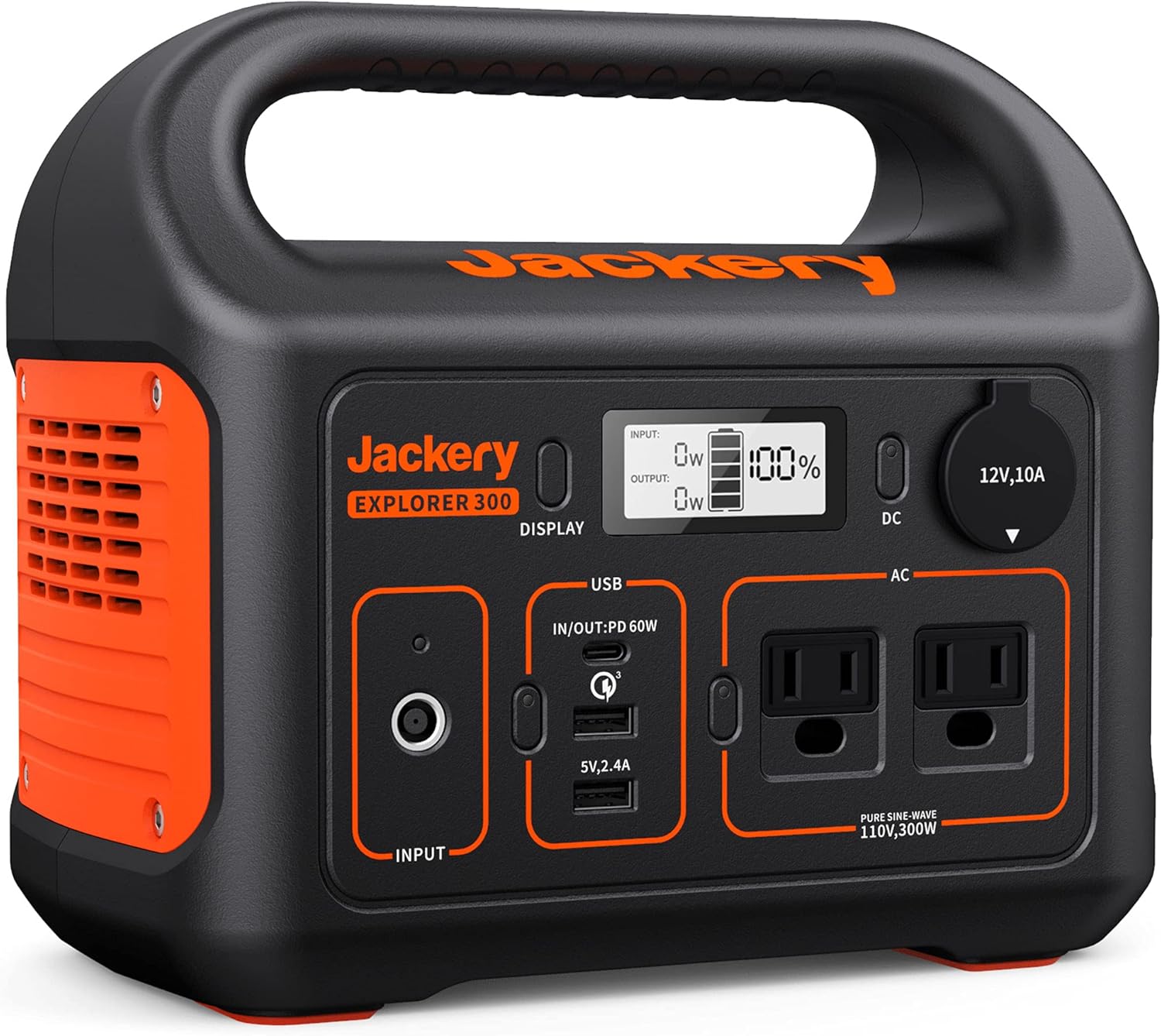
Pros
- Compact and lightweight design (7.1 lbs) makes it easy to carry to campsites, cabins, or roadside emergencies.
- Fast AC recharging (2 hours to 80%) and versatile solar input for sustainable off-grid power.
- Multiple ports including USB-C PD 60W and Quick Charge 3.0 to quickly charge modern devices.
- Reliable performance for CPAP machines, mini fridges, and small electronics based on user feedback.
Cons
- 293Wh capacity may not run high-wattage appliances like space heaters or full-size refrigerators.
- Limited to 300W continuous output; some tire inflators may not work at high battery charge due to safety cutoff.
- No built-in flashlight or app control found on higher-end models, and LiFePO4 battery not available in this version.
If you have been searching for a portable power station that balances size, weight, and capability, the Jackery Explorer 300 is a top contender. This compact unit packs a 293Wh lithium-ion battery and a 300W pure sine wave inverter into a 7.1-pound package that can easily fit in a backpack or under an RV seat. It is designed for campers, RV owners, road trippers, emergency preppers, tailgaters, and anyone who needs reliable portable power without noise or fumes.
Based on product specifications and user feedback, the Explorer 300 excels at keeping essential devices running. It can power a CPAP machine for a full night (around 8 hours using 51% capacity), charge a smartphone 15-20 times, or run a 60W mini fridge for about 4 hours. The two pure sine wave AC outlets deliver clean power safe for laptops, cameras, and medical equipment. In addition, there is a USB-C PD 60W port for fast laptop charging, a Quick Charge 3.0 USB-A port, a standard USB-A port, and a 12V car port. This variety makes it easy to charge up to six devices at once.
Recharging is straightforward and fast. Using the included AC wall adapter, you can reach 80% in about 2 hours and a full charge in roughly 4 hours. For off-grid adventures, plugging in a Jackery SolarSaga 100W solar panel (sold separately) fully recharges the station in about 5.5 hours thanks to the built-in MPPT controller. You can also charge from a car outlet during a road trip. The pass-through charging feature allows you to power devices while the station itself is recharging, which is handy during a power outage or at a campsite.
The build quality reflects Jackery's reputation. The rugged plastic housing has no sharp corners, and the unit feels solid. It operates silently and produces zero emissions, so you can use it inside a tent, RV, or cabin without worry. The LED display clearly shows remaining battery percentage, input/output wattage, and other status indicators. The battery management system (BMS) protects against overvoltage, short circuits, and temperature extremes, adding peace of mind. Jackery backs the Explorer 300 with a 2-year warranty, extendable to 3 years with registration.
One realistic limitation is that the 293Wh capacity and 300W output cannot handle high-wattage appliances like space heaters, hair dryers, or large refrigerators. Some users also note that the unit may not start a 12V tire inflator when the battery charge is above 50% due to a safety feature. Additionally, this model uses lithium-ion batteries rather than the newer LiFePO4 chemistry found in some competitors, so cycle life is slightly lower. Despite these points, many users find the Explorer 300 more than adequate for weekend camping trips, emergency backup, and daily portable use.
Overall, the Jackery Explorer 300 is a practical choice for anyone who needs a lightweight, quiet, and versatile power source. Campers will appreciate its portability and solar compatibility; preppers will value its quick AC recharge and silent operation during blackouts; road trippers can keep devices charged while driving. For small to medium power needs, this station delivers reliable performance without breaking the bank. If your power demands are modest and you prioritize portability, the Explorer 300 is well worth considering for your next outdoor adventure or emergency kit.


Pros
- Wireless charging works with most phones and AirPods, adding convenience.
- 20W fast charging via USB-C quickly tops up devices.
- Dual LED flashlight is bright and includes SOS mode for emergencies.
- Rugged build with IPX5 waterproof rating and shockproof design.
- Compact and lightweight for easy portability on hikes or in a bag.
Cons
- Solar charging is very slow; it's best used as a backup, not a primary charging method.
- 10,000mAh capacity may not be enough for multiple device charges on longer trips.
- Wireless charging pad placement can be finicky and requires precise alignment.
The BLAVOR Solar Power Bank is a versatile portable charger designed for outdoor enthusiasts, campers, hikers, and anyone who needs reliable backup power away from wall outlets. With a 10,000mAh capacity, it offers enough juice to charge a typical smartphone two to three times, making it suitable for weekend camping trips, day hikes, or emergency preparedness kits. Its standout features include built-in wireless charging up to 10W and a 20W USB-C fast charging port, which can bring an iPhone 15 to 65% in just 30 minutes according to the manufacturer.
In terms of battery performance, the real-rated capacity ensures you get the full 10,000mAh, and the power bank holds its charge well over time. The 20W USB-C output is a major plus for fast charging recent smartphones and tablets. The wireless charging pad works with most Qi-compatible devices, including AirPods, though placement requires a bit of care. The integrated solar panel is a nice backup, but it's slow (max 0.23A) and best used to trickle charge the bank over a full day in direct sunlight. Most users will rely on the included USB-C cable for primary charging.
Build quality is a highlight. The outer shell uses flame-retardant ABS and PC materials, with a rubberized skin-feel coating that provides a comfortable grip. It's rated IPX5 waterproof, meaning it can handle rain, splashes, and dusty conditions without issue. The dual LED flashlight is surprisingly bright and features a steady mode and SOS flashing, which is handy for tent setup, night walks, or signaling. A built-in compass carabiner adds extra utility for clipping to a backpack or belt loop.
Portability is excellent: the unit weighs just 9.3 ounces and measures 5.9 x 3.1 x 0.8 inches, easily slipping into a pocket or small pouch. The four LED battery indicators give a clear readout of remaining charge. Operation is simple: press the power button to check battery level or start charging. The power bank is also airline approved, so you can bring it on flights without hassle.
Realistically, the solar charging is not a primary power source; it's a useful emergency trickle. The 10,000mAh capacity is adequate for a day or two of moderate use, but heavy users may want a larger capacity. The wireless charging pad works well but can be a bit finicky with phone cases. Overall, the BLAVOR power bank is a well-rounded, affordable option for campers, hikers, and anyone building a go-bag for emergencies.
For its price, this power bank offers great value. It's a practical gift for outdoor lovers, a reliable companion for short trips, and a solid addition to any emergency kit. If you need a durable, compact, and feature-rich portable charger, the BLAVOR Solar Power Bank is a strong choice.

Frequently Asked Questions
Can a solar power bank recharge solely from sunlight?
Yes, but full solar replenishment takes significant time due to the modest surface area of compact panels. Single-panel solar power banks operate primarily as emergency backup systems rather than rapid daily rechargers. Multi-panel foldable models like the SOARAISE pack collect solar energy much faster by expanding surface exposure. Plugging the unit into a wall outlet before your trip guarantees a full charge before relying on daylight maintenance.
How does auto-restart technology improve portable solar charging in 2026?
Auto-restart circuitry restores full power output immediately after intermittent cloud cover or trail shadows pass. Standard portable solar panels often lock into a reduced trickle rate once shaded, failing to recover when direct sun returns. Integrated auto-reset chips sense peak illumination and reboot the connection automatically. This prevents interrupted charging sessions and ensures your devices receive steady wattage throughout changing weather conditions.
Can these solar battery chargers power a laptop computer?
Yes, but only models equipped with dedicated AC outlets or high-output USB-C ports can handle laptop power draws. Compact battery banks are engineered for phones and small gadgets, similar to specialized portable chargers for iPhone models. Larger power stations like the Jackery Explorer 300 provide 300W pure sine wave AC power and 60W USB-C delivery, which effortlessly run MacBooks, camera rigs, and drones.
What is the difference between IPX5 and IP65 water resistance?
IP65 provides complete dust sealing along with protection against low-pressure water jets, while IPX5 resists water sprays without certified dust protection. Units with IP65 ratings, such as the BLASOUL battery bank, handle dirt, mud, and heavy rains across rugged environments. IPX5 designs survive light rainfall and accidental splashes as long as rubberized port covers stay firmly sealed. Higher ingress ratings ensure reliable performance during severe wilderness downpours.
Is it safe to charge a solar battery pack on a vehicle dashboard?
No, placing a solar battery pack behind car glass can cause dangerous heat buildup. Tinted automotive glass blocks significant ultraviolet and infrared light, dramatically lowering solar conversion rates. Trapped vehicle heat can easily exceed safe operating temperatures for lithium-polymer cells, triggering battery degradation. Placing your solar charger outdoors in open air ensures optimal sunlight absorption while preventing dangerous thermal stress.


Write Your Review
No reviews yet. Be the first to share your experience!