

Watching a laptop battery drop to zero while working far from an electrical outlet creates instant stress. Remote setups demand reliable energy, yet finding gear with sufficient wattage requires looking past basic marketing claims. Evaluating the true solar laptop charger price means balancing solar panel surface area, storage capacity, and port capabilities instead of settling for underpowered hardware. If you plan remote work sessions, packing the best portable charger for travel helps keep your essential electronics operational before outdoor conditions drain your screen.
Modern field gear combines rugged exterior shells, integrated safety protections, and multi-protocol fast charging to keep critical hardware running smoothly. Dependable mobile power relies on high-output USB-C Power Delivery, efficient monocrystalline solar cells, and stable battery chemistry like LiFePO4 cells that outlast standard options. Factoring real capabilities against the advertised solar laptop charger price ensures your portable setup handles intermittent shade without stalling your workday. Capable power banks and compact power stations deliver peace of mind when wall outlets stay completely out of reach.

Pros
- Built-in cables and wireless Apple Watch charging reduce the need to carry extra cords
- 20000mAh capacity provides multiple full charges for smartphones and small devices
- Rugged IPX5 waterproof, dustproof, and shockproof design handles outdoor conditions well
- Versatile accessory tools like flashlight, compass, and bottle opener add convenience for camping and emergencies
Cons
- Solar charging is slow and best used as a backup rather than primary charging method
- Weighs 1.72 pounds, which may feel heavy for ultralight backpackers
- Wireless charging is limited to Apple Watch only, not compatible with other smartwatches or phones
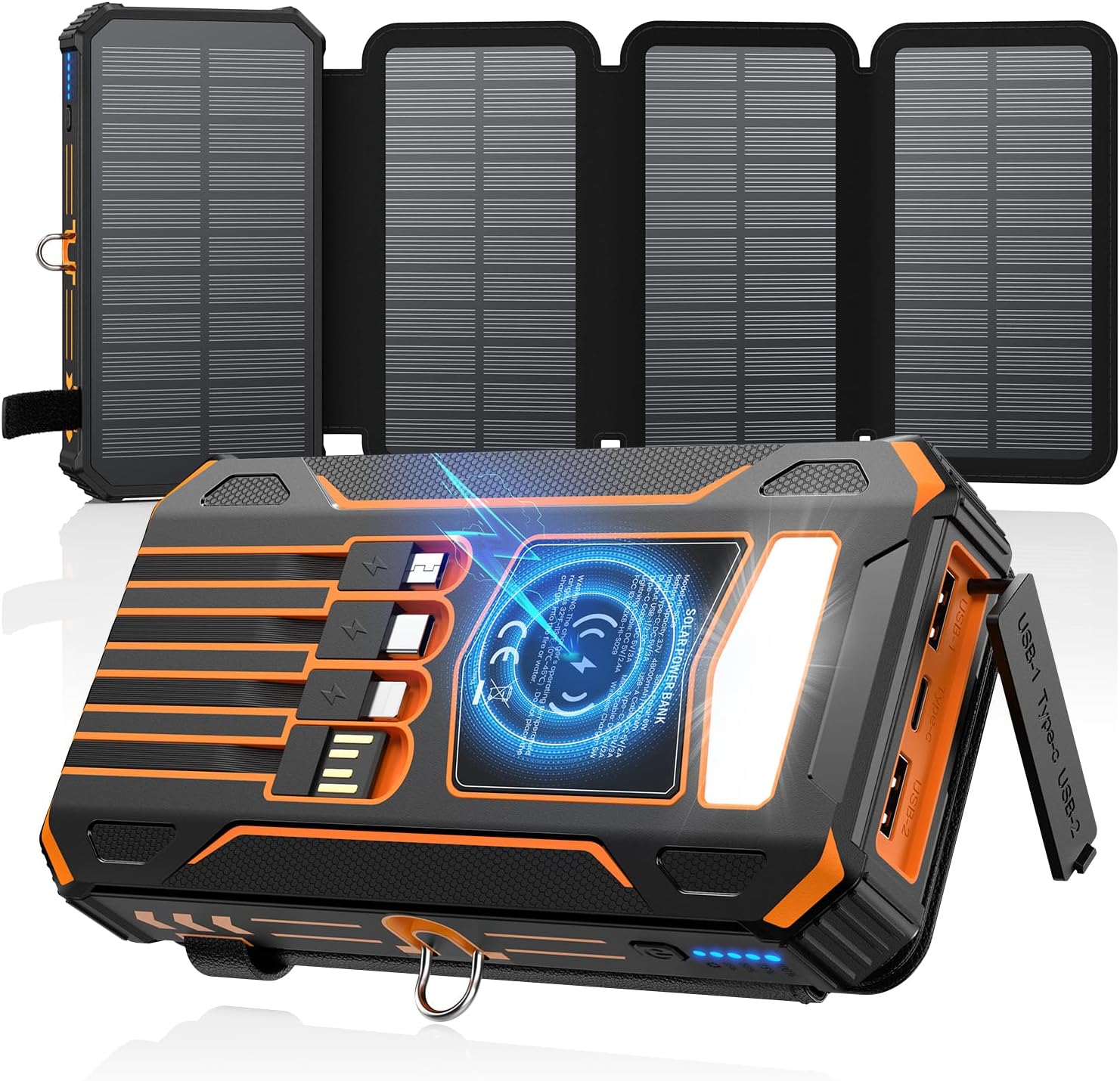
The BLAVOR Solar Power Bank is a versatile 20000mAh portable charger designed for outdoor enthusiasts, campers, RV owners, and emergency preppers who need reliable power on the go. It combines a high-capacity lithium-ion battery with built-in cables, wireless Apple Watch charging, and a solar panel for backup charging. This power bank is built to handle rugged conditions with its IPX5 waterproof, dustproof, and shockproof construction, making it a practical companion for hiking, camping, tailgating, and power outages.
With 20000mAh capacity, this power bank can charge an iPhone 15 about 4.2 times, a Galaxy S23 about 3.6 times, or an Apple Watch 9 up to 45 times. The 20W USB-C port delivers fast charging, bringing an iPhone 15 to 60% in just 30 minutes. It features four built-in cables (two USB-C, one iOS, one USB-A) plus three additional ports, allowing you to charge up to six devices simultaneously. The dedicated wireless charging area for Apple Watch is a thoughtful addition for Apple users.
Build quality is a strong point with an IPX5 waterproof rating, dustproof seals, and shockproof silicone corners. The flame-retardant ABS+PC shell adds durability for drops and bumps. The power bank includes a flashlight with three modes, a camping lantern with three brightness levels, a red indicator light, compass, thermometer, carabiner, and a bottle opener. These features make it a practical all-in-one tool for camping, hiking, and emergency situations.
Charging the power bank itself takes about 5-6 hours via USB-C, while solar charging is slower and best reserved for emergencies. The built-in solar panel is a nice backup but not a primary charging method. The power bank supports pass-through charging, so you can charge the bank and your devices simultaneously. Safety features include overcharging, over-discharge, over-current, and short-circuit protection, giving peace of mind during use.
One limitation is the weight of 1.72 pounds, which may be noticeable for ultralight backpackers but is reasonable for a 20000mAh unit with built-in cables and rugged build. The solar charging is slow and weather-dependent, so it's best to rely on wall or car charging for regular use. The wireless charging pad only works with Apple Watch, not other smartwatches or phones. Some users may find the built-in cables short for certain setups.
Overall, the BLAVOR Solar Power Bank is a solid choice for campers, RV owners, tailgaters, and emergency preppers who want a durable, multi-device charger with extra outdoor-friendly features. Its rugged build, high capacity, and fast charging make it a practical companion for weekend camping trips, road trips, power outages, and everyday use. For the price, it offers excellent value for anyone needing a reliable portable power solution with added convenience tools.


Pros
- Remarkably compact and lightweight for the capacity, easy to toss in a backpack or glove compartment.
- Fast recharge capability (0-80% in 1.5 hours) means less downtime between uses.
- Multiple output ports including AC outlets, so you can power laptops, small appliances, and USB devices at once.
- LiFePO4 battery chemistry offers excellent longevity and safety, with thousands of charge cycles.
- Quiet operation with no loud fan, making it suitable for indoor or tent use.
Cons
- Limited to 100W continuous output, so it cannot run high-power appliances like heaters, kettles, or large refrigerators.
- Pass-through charging uses charge/discharge method rather than direct pass-through, which may stress the battery over time.
- Some users report a faint humming noise under load, though not disruptive in most environments.
The DARAN R100 Portable Power Station is a compact, lightweight power bank that bridges the gap between a standard USB power bank and a full-sized generator. With a 28,000mAh (89.6Wh) LiFePO4 battery and a 100W continuous output (200W surge), it's designed to keep your essential electronics running during camping trips, RV adventures, road trips, tailgating, power outages, and everyday use.
This unit is best suited for campers, RV owners, outdoor enthusiasts, emergency preppers, remote workers, van lifers, tailgaters, and anyone who needs a reliable, portable backup power source for low-wattage devices. It excels at charging smartphones, tablets, laptops, cameras, drones, mini-fridges, CPAP machines, LED string lights, and small fans. However, it won't run high-draw appliances like space heaters, electric kettles, or air conditioners.
Performance-wise, the R100 delivers solid runtime for its size. According to user feedback and specifications, it can power a typical laptop (45W) for about 2 hours, charge a smartphone multiple times, or keep a mini-fridge running for a couple of hours. The 100W AC output is pure sine wave, which is safe for sensitive electronics. Charging the station itself is impressively fast: using the AC wall charger and USB-C simultaneously, you can go from 0 to 80% in about 1.5 hours. It also supports solar charging (up to 40W via DC5521), making it a viable option for off-grid recharging.
Build quality is a standout feature. The LiFePO4 battery chemistry offers over 3,500 charge cycles, far outlasting standard lithium-ion batteries. The unit includes a comprehensive battery management system (BMS) with protection against overvoltage, overcurrent, short circuits, and temperature extremes. The casing is made from ABS plastic, which feels sturdy yet lightweight. The LED display clearly shows remaining battery percentage, though it's basic and doesn't show runtime estimates. The built-in flashlight with four brightness levels and SOS mode is a practical addition for emergencies.
Ease of use is straightforward: just plug in your devices and press the power button. The unit is silent during operation (no fan), though some users have noted a faint humming when powering devices under load. Storage is simple: turn it off, keep it in a dry, room-temperature place, and recharge every three months to maintain battery health. The included components are minimal (just the power station), so you'll need to supply your own wall charger, USB cables, and solar panel if desired.
Realistic limitations include the 100W cap, which means you can't run power-hungry gear. Also, the pass-through charging method is the charge/discharge type rather than direct pass-through, so it's best to charge the station fully before using it to power devices. A few users have reported that the unit didn't last as long as expected with very low-power loads (like string lights), but that may be due to the inverter's overhead. Overall, the DARAN R100 offers excellent value for its price point, providing a reliable, portable, and safe power solution for anyone who needs to keep their electronics charged on the go or during emergencies.
The DARAN R100 features seven output ports: two AC outlets (100W total, pure sine wave), two USB-C ports (one 45W PD, one 15W), two USB-A ports (one 18W QC, one 15W), and one DC5521 port (60W). This variety allows you to charge laptops, phones, tablets, cameras, and small appliances simultaneously. The USB-C PD port can fast-charge compatible laptops and phones. For input, the station supports AC wall charging (via included cable), USB-C PD charging (up to 45W), car charging, and solar charging (up to 40W via DC5521). The dual input capability (AC + USB-C) enables ultra-fast charging from 0-80% in about 1.5 hours. Note that the solar panel is not included, but any 40W panel with DC5521 output can be used.

Frequently Asked Questions About Solar Charging Gear
Can a portable solar power bank charge a laptop directly?
Yes, provided the power bank delivers adequate USB-C Power Delivery wattage. Most standard pocket chargers only supply 15W to 20W, which trickles slowly or fails to register on power-hungry computers. A capable power unit like a compact power station or high-wattage battery bank supplies 45W to 100W, making it suitable for modern notebooks. Understanding how many volts in a phone charger helps match voltage profiles to your specific computer needs.
What factors most influence the solar laptop charger price in 2026?
Battery capacity and total output wattage drive the retail cost of off-grid solar equipment. Units featuring advanced LiFePO4 battery chemistry or integrated AC inverter outlets carry higher price tags than pocket-sized solar banks. Multiple fast-charging protocols, specialized ports, and durable weatherproof enclosures also influence market pricing across brands.
How long does it take for a built-in solar cell to recharge a power bank?
Recharging fully via a single small solar cell typically requires several days of intense sunlight. Small integrated solar panels generate between one and two watts under ideal conditions, making solar input primarily an emergency backup. Wall outlets or high-wattage external folding panels provide faster everyday recharging before you head outdoors.
Does auto-restart technology matter when solar charging electronics?
Yes, auto-restart circuitry keeps devices charging after intermittent cloud cover passes overhead. Without this feature, passing shadows or tree cover can cause sensitive smartphones to reject current and stop drawing power completely. Intelligent controllers reset the power connection automatically once sunlight returns to normal intensity.
Can you leave a solar charger in a hot car or direct sun indefinitely?
No, excessive heat exposure can degrade internal lithium cells and reduce overall battery lifespan. Solar gear handles outdoor ambient temperatures well, but sealed car dashboards trap extreme heat that triggers thermal throttling. Placing the power pack in shaded cover while angling the solar panels toward the sun prevents battery overheating.


Write Your Review
No reviews yet. Be the first to share your experience!