

Miles away from the nearest wall outlet, watching a phone battery drop to single digits creates instant backcountry stress. Outdoor adventurers and storm preppers know that standard backup batteries eventually run dry without sunlight to restore them. Evaluating the actual solar mobile phone charger price against real charging output helps you avoid underpowered units that stall the moment a stray cloud rolls across the sky. While traditional battery packs store energy, pairing internal storage with folding panels or integrated cells ensures you can harvest clean current in remote areas. Anyone preparing for extended trail hikes or sudden grid blackouts needs dependable gear rather than exaggerated advertising claims.
Based on detailed manufacturer specifications and extensive outdoor user feedback, charging speed depends heavily on panel surface area, circuit quality, and port configuration. Pocket-sized solar banks often take dozens of hours of intense direct sunlight to refill completely, whereas multi-panel foldables generate faster current for modern phones. Upgraded units now feature fast charging USB-C Power Delivery, multi-device ports, and rugged IP65 water resistance to survive sudden mountain downpours. Pairing your setup with a dedicated portable charger for travel ensures you always have stable reserves ready before relying purely on sunlight. Understanding these hardware differences helps you balance pack weight against true off-grid capability.
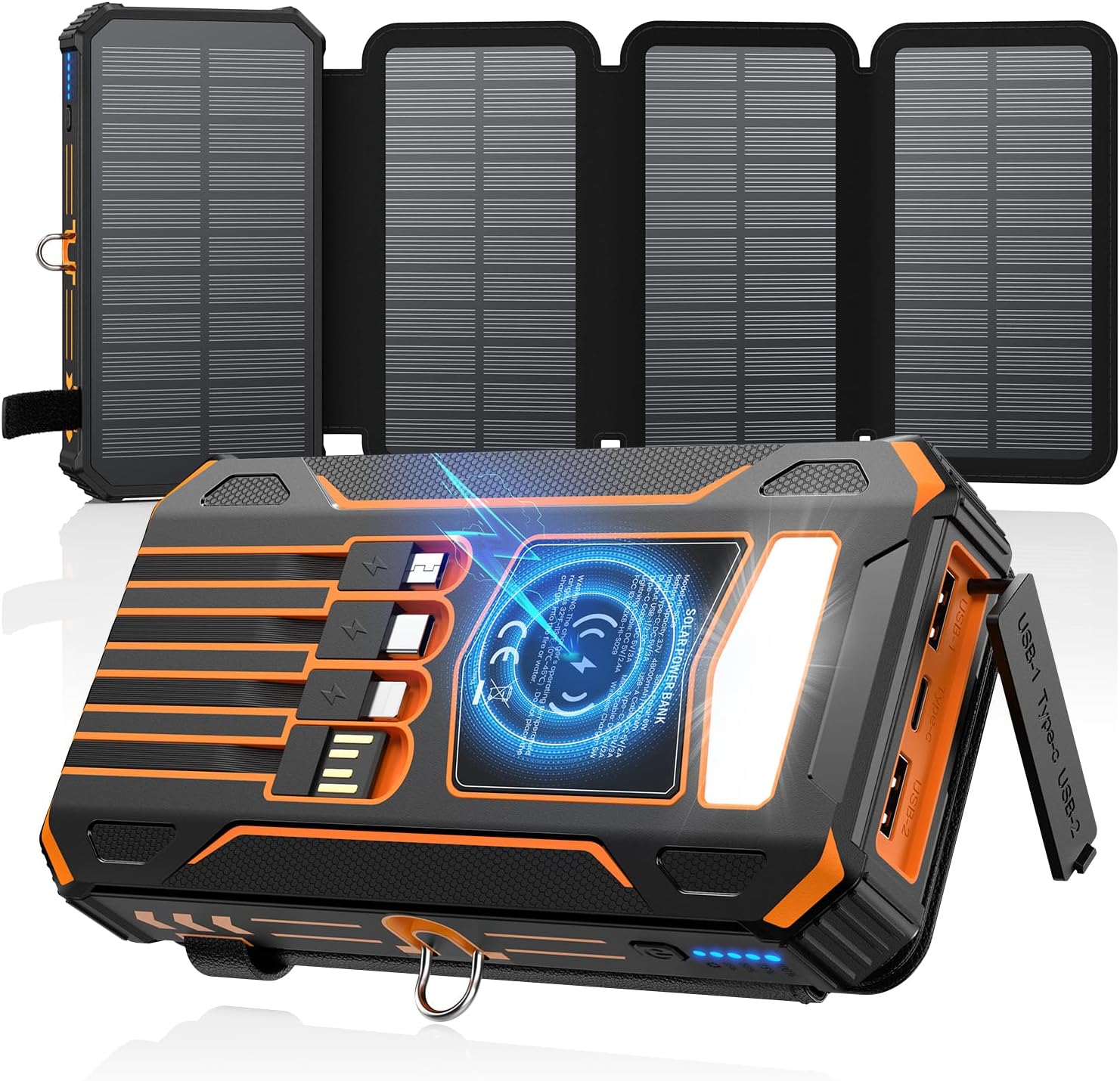
Pros
- Exceptional 48000mAh capacity for long trips
- Four built-in cables eliminate carrying separate cords
- Solar panels provide free renewable energy outdoors
- Wireless charging adds convenience for compatible phones
- Rugged, weather-resistant build handles rough use
Cons
- Solar charging speed depends on direct sunlight; may be slow on cloudy days
- No AC outlet; only USB and wireless outputs
- Weight of 1.5 pounds is reasonable but slightly heavier than basic power banks
The SOARAISE 48000mAh Solar Power Bank is a versatile portable charging solution designed for outdoor enthusiasts, campers, RV owners, and emergency preppers. Unlike standard power banks, it features four built-in solar panels that can harvest sunlight to recharge its massive battery, making it a reliable companion for off-grid adventures, power outages, or extended road trips. With a high-capacity lithium-polymer cell and multiple charging options, this unit aims to keep your devices powered without relying on wall outlets.
This power bank is best suited for campers spending days in the wilderness, RV boondockers needing backup power for phones and tablets, tailgaters who want to keep music playing, and homeowners preparing for storm-related outages. Remote workers, van lifers, and parents on-the-go will also appreciate the ability to charge several devices simultaneously. With its rugged, weather-resistant design, the SOARAISE can be tossed into a backpack, glove box, or emergency kit without worry.
According to the product specifications, the 48000mAh battery can recharge a typical smartphone six to eight times or a tablet two to three times. The four built-in cables (USB-C, iOS, USB-A, Micro) plus three USB ports and a wireless charging pad allow up to seven devices to charge at once, a huge convenience when traveling with family or sharing power. The 5V/3A USB-C port supports fast charging, and the wireless pad adds cable-free convenience for Qi-compatible phones. While there's no AC outlet, the multiple USB options cover most portable electronics.
Build quality is emphasized with waterproof, shockproof, and dustproof construction, plus a built-in LED flashlight for emergencies. The 1.5-pound weight and compact dimensions (6.38 x 3.43 x 1.57 inches) make it portable enough for everyday carry yet substantial enough to hold a large capacity. The integrated solar panels use monocrstalline cells for higher efficiency, though their output depends on direct sunlight. In sunny conditions, the four panels can replenish the battery faster than a single-panel charger, but cloudy days will extend recharge times significantly.
A few realistic limitations include the lack of an AC outlet, so you cannot power laptops or small appliances directly. Also, the solar charging is best used as a supplementary source rather than the primary recharging method; wall charging via the USB-C input is faster and more reliable. The orange color may not appeal to everyone, but it adds visibility outdoors. Some users may find the 1.5-pound weight slightly heavier than typical 20000mAh power banks, but the increased capacity and solar panels justify the trade-off.
Overall, the SOARAISE 48000mAh Solar Power Bank offers a well-rounded package for anyone needing off-grid power for multiple USB devices. It's a practical gift for outdoor lovers, a solid emergency backup for home, and a convenient travel companion. While it can't replace a full solar generator for heavy AC loads, it excels at keeping phones, tablets, cameras, and other USB gadgets juiced up anywhere. If you prioritize high capacity, built-in cables, and solar recharging in a durable form factor, this power bank is worth considering.
The SOARAISE power bank employs four monocrystalline solar panels that work together to harvest sunlight efficiently. According to the manufacturer, these panels charge up to five times faster than a single-panel design, which is a significant advantage when you're off the grid. However, keep in mind that solar charging speed varies with angle, cloud cover, and season. The panels can top off the internal battery over the course of a sunny day, making this unit a renewable power source for extended trips.
For charging devices, the power bank offers a wireless charging pad on top, plus three USB ports (two USB-A outputs and one USB-C input/output). Additionally, four cables are built right into the unit: USB-C, iOS, USB-A, and Micro-USB. This means you rarely need to dig for cords. The USB-C port supports 5V/3A input and output for fast charging, and the USB-A ports are standard 5V/2.4A. The wireless pad delivers standard Qi charging, compatible with iPhones and Galaxy models. You can charge up to seven devices at once, though total output is shared across the ports.
The SOARAISE solar power bank is built to handle the elements. The product description highlights its waterproof, shockproof, and dustproof design, meaning it can survive drops, rain, and dusty trails. The orange casing is rugged and textured for a secure grip, and the built-in flashlight with multiple modes (including SOS) is a handy feature for nighttime camping or emergencies. The integrated cables are well-secured and retractable, though care should be taken not to yank them excessively. The lithium-polymer battery inside is rated for extended cycle life, and the built-in protections help prevent overcharge, overcurrent, and short circuits. For anyone taking this power bank on demanding outdoor adventures, the build quality should give confidence.


Pros
- Wireless charging works with most phones and AirPods, adding convenience.
- 20W fast charging via USB-C quickly tops up devices.
- Dual LED flashlight is bright and includes SOS mode for emergencies.
- Rugged build with IPX5 waterproof rating and shockproof design.
- Compact and lightweight for easy portability on hikes or in a bag.
Cons
- Solar charging is very slow; it's best used as a backup, not a primary charging method.
- 10,000mAh capacity may not be enough for multiple device charges on longer trips.
- Wireless charging pad placement can be finicky and requires precise alignment.
The BLAVOR Solar Power Bank is a versatile portable charger designed for outdoor enthusiasts, campers, hikers, and anyone who needs reliable backup power away from wall outlets. With a 10,000mAh capacity, it offers enough juice to charge a typical smartphone two to three times, making it suitable for weekend camping trips, day hikes, or emergency preparedness kits. Its standout features include built-in wireless charging up to 10W and a 20W USB-C fast charging port, which can bring an iPhone 15 to 65% in just 30 minutes according to the manufacturer.
In terms of battery performance, the real-rated capacity ensures you get the full 10,000mAh, and the power bank holds its charge well over time. The 20W USB-C output is a major plus for fast charging recent smartphones and tablets. The wireless charging pad works with most Qi-compatible devices, including AirPods, though placement requires a bit of care. The integrated solar panel is a nice backup, but it's slow (max 0.23A) and best used to trickle charge the bank over a full day in direct sunlight. Most users will rely on the included USB-C cable for primary charging.
Build quality is a highlight. The outer shell uses flame-retardant ABS and PC materials, with a rubberized skin-feel coating that provides a comfortable grip. It's rated IPX5 waterproof, meaning it can handle rain, splashes, and dusty conditions without issue. The dual LED flashlight is surprisingly bright and features a steady mode and SOS flashing, which is handy for tent setup, night walks, or signaling. A built-in compass carabiner adds extra utility for clipping to a backpack or belt loop.
Portability is excellent: the unit weighs just 9.3 ounces and measures 5.9 x 3.1 x 0.8 inches, easily slipping into a pocket or small pouch. The four LED battery indicators give a clear readout of remaining charge. Operation is simple: press the power button to check battery level or start charging. The power bank is also airline approved, so you can bring it on flights without hassle.
Realistically, the solar charging is not a primary power source; it's a useful emergency trickle. The 10,000mAh capacity is adequate for a day or two of moderate use, but heavy users may want a larger capacity. The wireless charging pad works well but can be a bit finicky with phone cases. Overall, the BLAVOR power bank is a well-rounded, affordable option for campers, hikers, and anyone building a go-bag for emergencies.
For its price, this power bank offers great value. It's a practical gift for outdoor lovers, a reliable companion for short trips, and a solid addition to any emergency kit. If you need a durable, compact, and feature-rich portable charger, the BLAVOR Solar Power Bank is a strong choice.

Frequently Asked Questions About Solar Phone Charging
Does a higher solar mobile phone charger price guarantee faster charging in sunlight?
Not necessarily, because solar cell surface area and panel wattage dictate charging speed far more than retail cost alone. A compact bank with a single solar cell generates minimal current compared to a multi-panel folding unit, regardless of price tag. Higher-priced models typically incorporate high-capacity lithium-polymer batteries, integrated cables, or magnetic wireless coils. When evaluating what you pay, check the number of unfolding panels and rated wattage rather than battery capacity alone.
Can you recharge a 50000mAh solar power bank using only its solar panel?
Yes, but relying solely on a small built-in solar cell takes several days of continuous direct sunlight to achieve a full charge. Small integrated panels produce between 1W and 2W under ideal sun, making them best suited for emergency trickle charging. Outdoor gear manufacturers recommend charging the battery pack completely from an AC wall outlet before leaving home. You should treat the onboard solar panel as an emergency backup rather than your primary daily refill method.
How does auto-restart technology protect mobile devices during solar charging?
Auto-restart circuitry automatically resumes full-speed charging once a passing cloud clears, preventing your smartphone from locking into a low-amperage state. Without this feature, minor shading can cause iPhones and Android devices to drop the charging connection or display an incompatible accessory error. Stable power delivery ensures your phone battery does not cycle on and off constantly under intermittent trail canopy. Understanding phone charger voltage output helps you select solar gear that maintains steady 5V to 9V delivery off-grid.
Can solar phone chargers charge smartphones through car or house windows?
No, window glass blocks and reflects a significant portion of the solar spectrum, severely reducing charging efficiency. Modern window coatings filter out UV and infrared wavelengths that photovoltaic cells rely on to produce electricity. Placing a solar charger on a sunny dashboard can also cause dangerous heat buildup, triggering your phone’s thermal protection shutoff. For maximum energy harvest, position the panels outdoors facing the sun at an unshaded angle.
Is magnetic wireless charging safe on portable solar power banks?
Yes, built-in magnetic wireless pads with intelligent protection chips prevent overheating, overcurrent, and short circuits. Units like the FEELLE power bank snap directly onto compatible smartphone cases to eliminate messy cord tangles around camp. If you want convenient cable-free power for your phone, pairing solar units with magnetic portable charger gear provides effortless alignment. Keep in mind that wireless charging produces slightly more heat and consumes more energy than direct USB-C cable connections.
What weather resistance rating should you look for in 2026 outdoor solar chargers?
An IP65 or IPX5 rating offers ideal protection against splashing rain, blowing dust, and accidental campsite spills. Tough ABS and polycarbonate shells with sealed silicone port covers prevent moisture from entering delicate electrical contacts during mountain storms. While these rugged casings handle damp environments and wet weather, you should never submerge solar battery banks in standing water. Always wipe moisture off the ports before connecting charging cables.


Write Your Review
No reviews yet. Be the first to share your experience!