

Dead phone batteries on remote backcountry trails can turn an exciting wilderness trek into a stressful ordeal when navigation maps go dark. Carrying a standard wall plug does not help in deep valleys, while an ordinary backup pack runs dry after a couple of days. Securing the best solar charger backpacking setup solves this off-grid headache by transforming direct sunlight into reliable energy for phones, GPS units, and headlamps. Whether you pack a lightweight folding solar array with high conversion efficiency or an integrated solar battery bank, reliable power generation keeps your vital trail electronics active past the trailhead.
Backpackers constantly balance carry weight against real-world charging speed, especially when passing cloud cover disrupts electricity flow. Modern trail panels feature resilient ETFE coating, high-yield monocrystalline cells, and smart auto-restart circuits that resume charging the instant a shadow drifts away. If you already carry a standard battery, pairing it with a folding panel or a dedicated reliable portable charger for travel gives you complete energy freedom. Our review analyzes manufacturer specifications, port configurations, weather resistance ratings, and user feedback to highlight rugged gear that delivers steady current in the wild.

Pros
- Ultra-light and compact design for easy portability on hikes or in go-bags
- Fast charging with both USB-A QC3.0 and USB-C PD for modern devices
- Durable IP67 construction resists rain, dust, and scratches for long outdoor life
Cons
- Requires direct sunlight for best performance; partial shade can reduce output significantly
- No built-in battery storage so it only works when the sun is shining
- DC port output limited to 40W max combined; charging two devices may slow each port
The FlexSolar 40W Foldable Solar Panel is a practical solar charger designed for outdoor enthusiasts who need to keep small electronics powered while away from wall outlets. It is a portable solar panel that converts sunlight into electricity, making it ideal for campers, hikers, backpackers, and emergency preppers who want to stay connected or keep devices running during off-grid adventures or power outages.
This panel is best suited for people who value lightweight gear and dependable charging on the move. At just 1.76 pounds and folding down to roughly the size of a small laptop, it slips easily into a backpack or emergency kit. With dual fast-charging outputs — a QC3.0 USB-A and a PD2.0 USB-C port, each capable of up to 18 watts — it can charge smartphones, tablets, power banks, and even some small GPS devices simultaneously. The 19V DC port adds versatility for powering compatible small solar generators directly.
According to product specs and user feedback, the monocrystalline cells achieve a 24% conversion efficiency, which is above average for panels in this class. That means it can charge a typical smartphone in a couple of hours under good sunlight. However, like all solar chargers, performance dips significantly in shade or cloudy conditions, so positioning is key. The included carabiners make it easy to attach to a tent, backpack, or tree. The IP67 waterproof rating and ETFE coating add peace of mind against rain, dust, and scratches during rugged use, though the junction box should be kept from heavy downpours.
Build quality feels solid for a foldable panel, with a durable fabric exterior and sturdy solar cells that resist wear. The smart IC chip automatically detects connected devices to optimize charging, and safety protections prevent overcurrent, overheating, and short circuits. There's no battery storage, so it works only when the sun shines, but it pairs well with a power bank for storing energy to use later. Some users note that charging one device at a time yields faster speeds than splitting power between two, which is a practical tip for efficient use.
While it's not meant to run large appliances or power a house, this panel excels at maintaining essential electronics for weekend campers, day hikers, or anyone building a lightweight emergency preparedness kit. Its portability and dependable solar conversion make it a smart choice for those who need a reliable trickle charger for phones, GPS units, or small power banks without adding much weight or bulk. For RV owners or van lifers who have more space and higher power needs, a larger panel might be more appropriate, but for backpacking or grab-and-go emergency use, the FlexSolar 40W is a well-rounded and practical solution.

Pros
- Lightweight and compact design makes it easy to carry on any outdoor adventure or store in an emergency bag.
- Multiple output ports (dual USB-C and USB-A) let you charge different devices at once, increasing efficiency.
- High solar conversion efficiency (25.4%) means you get more power from available sunlight compared to many competitors.
- Durable build with IP44 waterproof rating and polymer surface withstands outdoor elements and daily wear.
Cons
- Does not have a built-in battery, so it only charges devices when in direct sunlight and cannot store power for later use.
- Charging speed depends heavily on sunlight intensity and angle; performance drops significantly in cloudy or shaded conditions.
- Output limited to 5V/3A per port (12W max per port), which may be slow for larger power banks or devices that support faster charging.
The BigBlue 28W Solar Panel Charger is a portable solar charger designed to keep your essential electronics powered up when you are away from traditional outlets. It is best suited for campers, hikers, backpackers, RV owners, emergency preppers, outdoor enthusiasts, road trippers, van lifers, tailgaters, and anyone who spends time off-grid or wants a reliable backup power source for emergencies. This charger is also a practical gift for travelers, students, parents on-the-go, and homeowners preparing for power outages.
In real-world use, this solar panel delivers up to 28 watts of power from its high-efficiency solar cells, which convert 25.4% of sunlight into usable electricity. It features two USB-C ports and one USB-A port, each capable of outputting up to 5V/3A (12W), allowing you to charge multiple devices simultaneously like smartphones, power banks, GPS units, and headlamps. Keep in mind that actual charging speed depends on sunlight conditions; direct, bright sunlight yields the best results, while overcast skies or partial shade will slow charging significantly. The panel does not have a built-in battery, so it must be connected to your device while in the sun to charge.
Build quality is solid for a portable solar panel. The panels are made with advanced N-type solar cells and a shadow-free surface design that minimizes power loss from metal lines. The unit is rated IP44 waterproof, meaning it can withstand splashes and light rain, though the USB junction box is not fully waterproof and should be protected from direct water exposure. The foldable design is convenient: it folds to 11.1 x 6.3 x 1.34 inches and weighs just 1.48 pounds, making it easy to slip into a backpack or emergency kit. Four carabiners are included for attaching it to a backpack, tent, or other gear.
Ease of use is straightforward: simply unfold the panel in direct sunlight, connect your device via USB, and charging begins automatically. There are no buttons to press, and a blue LED light glows solid when charging properly. For best performance, keep the panel clean and free of shadows, and avoid using it behind glass windows, which can block up to 25% of sunlight. Some users find that propping the panel up with a stick or gear helps maintain an optimal angle toward the sun. The panel works well with power banks that draw low current, but some larger power banks may require a minimum current that the panel might not always provide under weaker sunlight.
One realistic limitation is that the charger relies entirely on sunlight; it cannot charge at night or in very low light. Also, each USB port is limited to 12W, which is fine for phones and small devices but may be slow for larger power banks or tablets. The panel's output is also affected by temperature, angle, and shadows, so patience is required. For longer trips, many users pair this panel with a power bank to store energy during the day and charge devices later. The included USB-C to USB-C cable is a nice addition, but Apple device owners will need their own Lightning cable.
Overall, the BigBlue 28W Solar Panel Charger is a reliable and portable solution for keeping small electronics charged during outdoor adventures or emergencies. It is not a fast charger, but it offers dependable off-grid power when you need it most. For campers, hikers, and preppers who want a lightweight, durable solar charger that can handle multiple devices, this is a solid choice that delivers good value for the price.

Pros
- Wireless charging works with most phones and AirPods, adding convenience.
- 20W fast charging via USB-C quickly tops up devices.
- Dual LED flashlight is bright and includes SOS mode for emergencies.
- Rugged build with IPX5 waterproof rating and shockproof design.
- Compact and lightweight for easy portability on hikes or in a bag.
Cons
- Solar charging is very slow; it's best used as a backup, not a primary charging method.
- 10,000mAh capacity may not be enough for multiple device charges on longer trips.
- Wireless charging pad placement can be finicky and requires precise alignment.
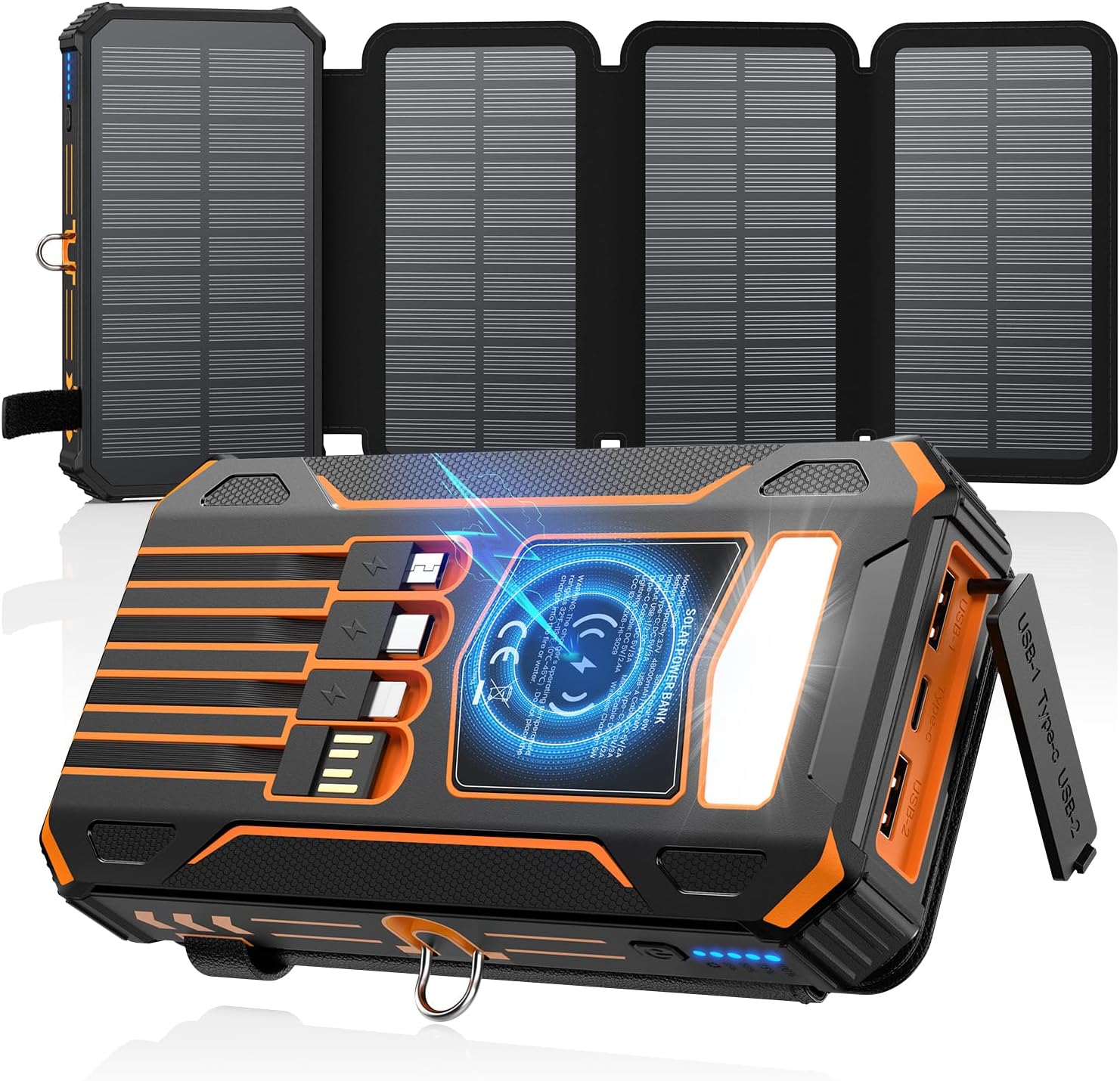
The BLAVOR Solar Power Bank is a versatile portable charger designed for outdoor enthusiasts, campers, hikers, and anyone who needs reliable backup power away from wall outlets. With a 10,000mAh capacity, it offers enough juice to charge a typical smartphone two to three times, making it suitable for weekend camping trips, day hikes, or emergency preparedness kits. Its standout features include built-in wireless charging up to 10W and a 20W USB-C fast charging port, which can bring an iPhone 15 to 65% in just 30 minutes according to the manufacturer.
In terms of battery performance, the real-rated capacity ensures you get the full 10,000mAh, and the power bank holds its charge well over time. The 20W USB-C output is a major plus for fast charging recent smartphones and tablets. The wireless charging pad works with most Qi-compatible devices, including AirPods, though placement requires a bit of care. The integrated solar panel is a nice backup, but it's slow (max 0.23A) and best used to trickle charge the bank over a full day in direct sunlight. Most users will rely on the included USB-C cable for primary charging.
Build quality is a highlight. The outer shell uses flame-retardant ABS and PC materials, with a rubberized skin-feel coating that provides a comfortable grip. It's rated IPX5 waterproof, meaning it can handle rain, splashes, and dusty conditions without issue. The dual LED flashlight is surprisingly bright and features a steady mode and SOS flashing, which is handy for tent setup, night walks, or signaling. A built-in compass carabiner adds extra utility for clipping to a backpack or belt loop.
Portability is excellent: the unit weighs just 9.3 ounces and measures 5.9 x 3.1 x 0.8 inches, easily slipping into a pocket or small pouch. The four LED battery indicators give a clear readout of remaining charge. Operation is simple: press the power button to check battery level or start charging. The power bank is also airline approved, so you can bring it on flights without hassle.
Realistically, the solar charging is not a primary power source; it's a useful emergency trickle. The 10,000mAh capacity is adequate for a day or two of moderate use, but heavy users may want a larger capacity. The wireless charging pad works well but can be a bit finicky with phone cases. Overall, the BLAVOR power bank is a well-rounded, affordable option for campers, hikers, and anyone building a go-bag for emergencies.
For its price, this power bank offers great value. It's a practical gift for outdoor lovers, a reliable companion for short trips, and a solid addition to any emergency kit. If you need a durable, compact, and feature-rich portable charger, the BLAVOR Solar Power Bank is a strong choice.

Pros
- Lightweight and pocket-friendly design makes it easy to carry on hikes, flights, or daily commutes
- 20W USB-C fast charging dramatically reduces charge time for modern smartphones and tablets
- Wireless charging pad adds convenience for Qi-compatible devices without extra cables
- Rugged IPX5 waterproof and shockproof build withstands outdoor conditions and accidental drops
- Dual LED flashlights with a compass carabiner provide practical emergency lighting and navigation
Cons
- Solar panel charging is extremely slow (works best only in direct sunlight) and serves mainly as an emergency backup
- 10,000mAh capacity may not fully charge larger devices like iPad Pro more than once, and capacity decreases with age
- No AC outlet or high-wattage output, so it cannot power laptops or larger electronics
The BLAVOR Solar Power Bank is a compact 10,000mAh portable charger that combines USB-C fast charging, wireless Qi charging, and a built-in solar panel for off-grid power. It is designed for campers, hikers, road trippers, emergency preppers, and anyone who needs a reliable backup power source for their smartphone, tablet, or wireless earbuds while outdoors.
Target users include outdoor enthusiasts who want a lightweight, rugged power bank for weekend camping trips, day hikes, or beach outings. It also suits travelers, van lifers, and gift buyers looking for a practical white elephant present. Parents on-the-go may appreciate the dual flashlights for nighttime stargazing or emergency situations. Remote workers or students who need a quick top-up during a power outage will find the 20W USB-C fast charging valuable.
In terms of performance, the 10,000mAh Li-cobalt battery can charge an iPhone 14 Pro about 2.2 times or an iPad Air once. The 20W USB-C output can charge an iPhone 15 to 65% in 30 minutes. Wireless charging works for Qi-enabled phones at 10W max. The solar panel is small and primarily a backup feature; under bright sun it may trickle charge the internal battery but is not a primary charging method. The power bank can charge three devices at once via USB-A, USB-C, and the wireless pad. It does not include a wall charger, but a USB-C cable is provided.
Build quality is a highlight: the outer case uses flame-retardant ABS and PC materials, with a waterproof silicone layer inside. The rubberized skin-feel coating provides a comfortable grip and protects against drops. The IPX5 rating means it can withstand rain, splashes, and dust. Dual super-bright flashlights have a SOS mode and a compass carabiner adds safety. The battery management system protects against overcharge, short circuits, and temperature extremes.
Setup is straightforward: charge the power bank via USB-C (using a wall charger, not included) and it is ready to go. The flashlights are controlled by a single button. Storage and maintenance are simple, but note that solar charging should be used only as a last resort. A realistic limitation is that the 10,000mAh capacity is moderate; heavy users may need a larger power bank for multi-day trips. Also, solar charging is slow and impractical in cloudy weather.
Overall, the BLAVOR Solar Power Bank is a solid choice for anyone seeking a durable, compact, and fast-charging portable battery with emergency features. It works best as a daily carry for quick device top-ups, a lightweight camping companion, or a thoughtful gift for outdoor lovers. For serious off-grid needs, consider a larger solar generator, but for smartphone-level backup in a rugged package, this power bank may fit the bill.
The BLAVOR power bank features a 10,000mAh Li-cobalt battery, which offers about 50% more charge cycles than standard Li-polymer batteries. Based on typical usage, a full charge can provide approximately 3.6 full charges for an iPhone 8, 2.2 charges for an iPhone 14 Pro, or one charge for an iPad Air. The battery itself takes about 4-5 hours to fully charge via a 20W USB-C wall adapter (not included). Solar charging is much slower; under direct sun, it may take several days to fully recharge the bank. The battery management system helps maintain battery health and longevity.
Weighing only about 6.7 ounces and sized slightly smaller than a smartphone, the BLAVOR power bank is designed for pocketability. The rubberized skin coating provides a tactile grip and protects against scratches and drops. A built-in compass carabiner allows it to be clipped onto a backpack or belt loop. The dual LED flashlights are bright enough for walking at night or setting up camp. The overall design is sleek and utilitarian, fitting easily into a jacket pocket or small pouch.
Frequently Asked Questions
How do standalone folding panels compare to solar power banks for backpacking?
Standalone folding solar panels produce significantly more usable electricity in direct sunlight than pocket-sized solar power banks. A 28W or 40W foldable array provides ample surface area to recharge handheld devices and power packs in just a few hours. In contrast, compact solar power banks with a single built-in solar cell take multiple days of full sun exposure to recharge from zero, making them better suited as pre-charged battery packs with emergency trickle backup for 2026.
Can you charge a smartphone directly from a portable solar panel?
Yes, modern portable panels can charge smartphones directly, but sending that current into an intermediate power bank is often the safer strategy. Direct sun exposure can quickly cause a phone left on a hot rock to overheat and halt its charging cycle. Knowing how many volts in a phone charger circuit are required helps you understand why variable direct solar output can sometimes cause sensitive handsets to reject incoming current.
What does auto-restart technology do on a backpacking solar charger?
Auto-restart technology automatically restores optimal charging current to connected devices once intermittent shade or cloud cover clears. Without this feature, momentary shade from trail trees causes panel voltage to drop, which prompts many modern smartphones to stop charging until manually unplugged and reconnected. High-grade gear for Best Solar Charger Backpacking uses integrated smart IC chips to handle shifting light levels without interrupting your power flow.
What makes ETFE coating better than PET lamination for trail use?
ETFE coating provides superior heat tolerance, UV resistance, and scratch protection compared to standard PET laminates. The textured ETFE surface allows higher sunlight penetration, resists delamination across long hiking seasons, and handles dirt or dust much better. While PET panels cost less initially, ETFE-coated models deliver substantially greater long-term durability in rugged backcountry environments.
Are backpacking solar chargers fully waterproof in heavy rain?
Most solar panel surfaces resist water spray, but their electrical junction boxes and USB ports are rarely submersible. Panels with IP67 or IP44 ratings easily withstand mist and unexpected mountain storms across the cell faces, yet moisture inside open ports can cause short circuits. Keeping open cable connections safely inside a pack pouch protects your gear when rain begins. If you carry specialized portable chargers for iPhone setups, keeping terminal ports dry remains essential during sudden trail storms.
How does panel wattage affect real-world charging speeds in 2026?
Real-world solar power generation typically delivers 50% to 75% of a panel’s rated wattage due to sun angle, haze, and operating heat. A panel rated for 28W or 40W generally produces between 14W and 30W under regular outdoor conditions, which provides plenty of current for quick phone refills. Ultralight panels rated under 15W frequently struggle to generate sufficient amperage for fast-charging protocols unless environmental conditions are completely flawless.



Write Your Review
No reviews yet. Be the first to share your experience!