

Eliminating Overnight Range Anxiety with Dedicated EV Power
Plugging an electric vehicle into a standard wall outlet often feels like filling a swimming pool with a garden hose. Trickle charging barely adds three to four miles of range per hour, leaving daily commuters with an empty battery by sunrise. Upgrading to a 240-volt setup lets drivers bypass crowded public stalls, slash utility bills during off-peak windows, and hit the road every morning with a full pack. Deciding to buy an electric car charging station gives you total control over daily charging speeds while protecting your vehicle battery with stable, regulated amperage.
Modern hardware ranges from flexible dual-voltage travel cords to heavy-duty 40-amp garage units that maximize a standard 50-amp circuit breaker. While some drivers prefer permanent wall stations, others lean toward versatile units that double as travel gear alongside the best portable charger for car road trips. Evaluating your home electrical panel capacity, continuous load safety limits, outlet standards like NEMA 14-50, and weatherproof ratings ensures reliable power across freezing winter nights and sweltering summer afternoons without tripping domestic breakers.

Pros
- Fast 9.6kW charging with adjustable amperage for customized speed
- Portable design with carry bag and holders for easy transport and storage
- Wide compatibility with all J1772 EVs and hybrids (Tesla requires adapter)
- Excellent weather resistance with IP66 rating for outdoor use in any climate
Cons
- Does not include a Tesla adapter, so Tesla owners need to purchase separately
- Requires a 50A circuit breaker, which may not be available in all homes or older RV parks
- Control box is somewhat bulky, adding weight during travel
The EVDANCE Level 2 EV Charger is a portable electric vehicle charging station designed for EV owners who need fast, reliable charging at home or on the go. With a NEMA 14-50 plug and adjustable current from 10A to 40A, this charger offers flexibility for various scenarios, whether you are topping off at work, charging overnight at home, or plugging in at an RV park during a road trip. It is best suited for EV owners, road trippers, RV enthusiasts, homeowners, and anyone who wants a portable charging solution that can handle different power conditions.
Performance-wise, the EVDANCE charger delivers up to 9.6kW of power, charging your EV roughly 8 times faster than a standard Level 1 charger. The adjustable current settings (10A, 16A, 20A, 24A, 32A, 40A) let you match the charging speed to your electrical circuit, preventing tripped breakers in older homes or campsites. The delayed charging function allows you to set a timer from 1 to 12 hours, so you can charge during off-peak hours and save on electricity costs. The 2.4-inch TFT display provides clear real-time information on charging current, voltage, power, and time, while the LED indicator shows the charging status at a glance.
Build quality is robust, with an IP66 weatherproof rating that protects against dust and powerful water jets, making it suitable for outdoor use in rain, snow, or direct sunlight. The charger operates in temperatures from -22°F to +122°F, so it can handle harsh weather conditions. Safety features include built-in protection against leakage, grounding issues, overvoltage, undervoltage, overcurrent, overcharging, overheating, and short circuits. The charger automatically shuts off when your vehicle is fully charged, which adds peace of mind and protects your car's battery.
Portability is a key strength. The 25-foot cable gives you plenty of reach, and the included carry bag, cable holder, and control box holder make it easy to store and transport. At 11.58 pounds, it is light enough to keep in your trunk for emergency charging or to bring along on camping trips. Setting up the charger is straightforward: plug it into a NEMA 14-50 outlet, connect the J1772 connector to your vehicle, and adjust the current as needed. No complex installation is required, making it beginner-friendly.
Realistically, there are a few limitations. The charger does not include a Tesla adapter, so Tesla owners will need to purchase one separately. It also requires a 50A circuit breaker, which may not be available in all homes or older RV parks. Some users may find the control box a bit bulky, but the overall design is still manageable for travel. Additionally, while the charger is weather-resistant, it is not designed for submersion, so avoid using it in standing water.
Overall, the EVDANCE Level 2 EV Charger is a practical investment for EV owners who want a fast, adjustable, and portable charging solution. It is especially useful for road trips, RV adventures, and home charging where flexibility and reliability matter. If you have a J1772-compatible EV and need a charger that can handle various conditions without breaking the bank, this model delivers solid performance and value.
Pros
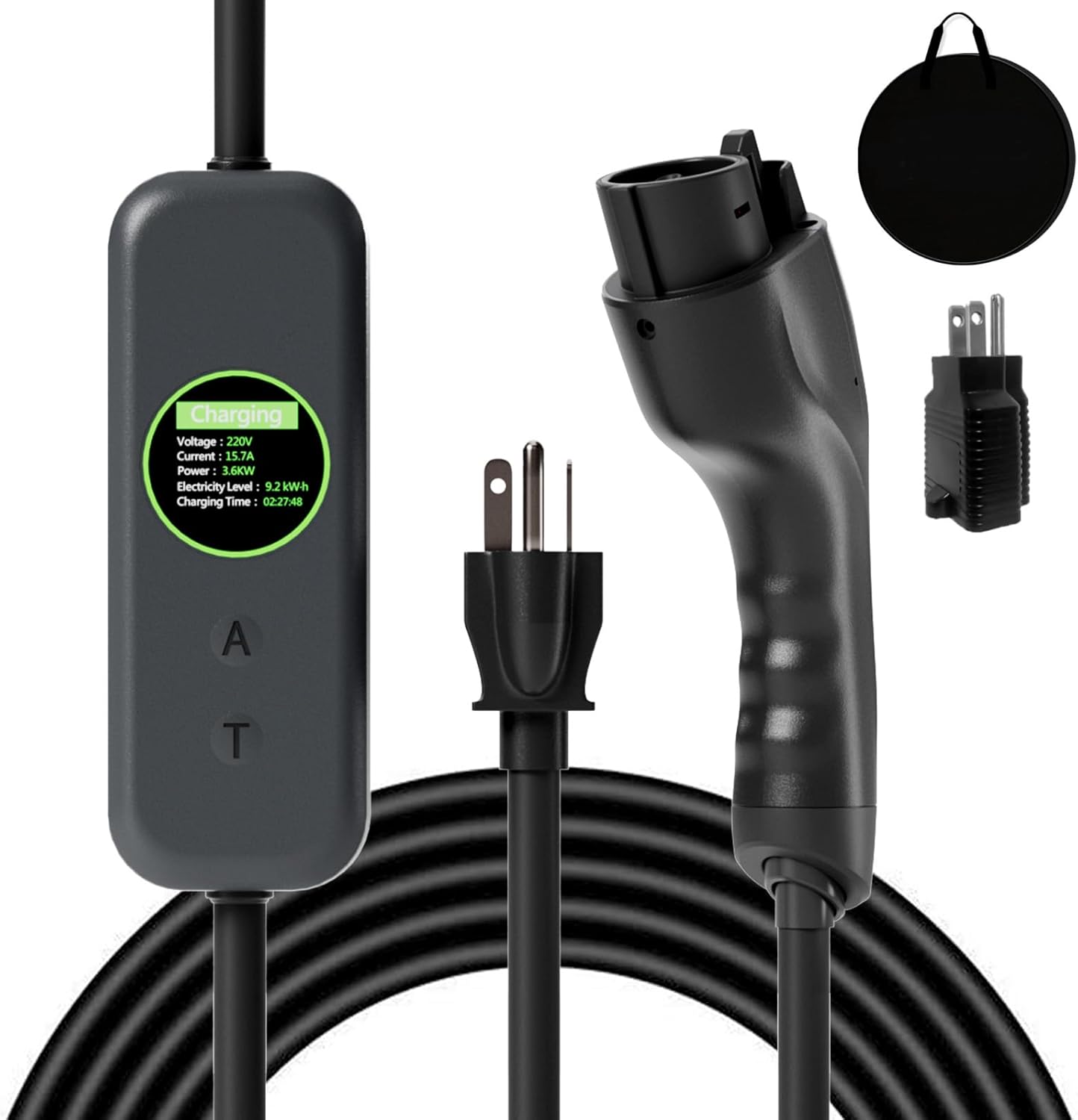
- Compact and lightweight at under 5 pounds, easy to store in your car trunk or garage
- Simple plug-and-play setup with clear LCD display and intuitive button controls
- Scheduled charging helps you take advantage of lower electricity rates overnight
- Affordable price point makes it an excellent backup or secondary charger for EV owners
Cons
- Cord length is only about 16 feet, which may be too short for some parking layouts
- Some users report the J1772 connector fits tightly in certain vehicles like Toyota bZ4X and Nissan Leaf
- Lacks built-in GFCI protection, so using a GFCI outlet or breaker is recommended for safety
The Toptoo 16A Portable EV Charger is a Level 1+2 electric vehicle charging station designed for EV owners who need a dependable, travel-friendly charging solution. It combines the convenience of a compact portable unit with the performance of a 16-amp, 3.5-kilowatt charger, making it suitable for both everyday home use and on-the-road top-ups. Whether you’re a road tripper, an emergency prepper, or simply an EV driver looking for a backup charger to keep in the trunk, this unit offers a practical balance of features and affordability.
In terms of performance, the Toptoo charger can operate on standard 110V household outlets (Level 1) or 240V NEMA 6-20P outlets (Level 2). At 16 amps and 3.5kW, it adds roughly 12-15 miles of range per hour on a 240V circuit—enough to fully charge many EVs overnight. The adjustable current setting lets you dial down the amperage if your outlet or wiring can’t handle the full 16A, which is a smart safety feature. The LCD color display provides clear real-time data on current, voltage, power, temperature, and charging status, so you always know what’s happening. Scheduled charging is also available, allowing you to set a delayed start or a charging duration limit.
Build quality appears solid based on user feedback. The main control unit feels sturdy, the cable is well insulated, and the internal construction is clean. The 16-foot cord is thick and durable, though some users may find it a bit short for certain garage layouts or public charging scenarios. The J1772 connector is a standard 5-pin design, but a few reviewers noted it can be tight to insert or remove on some models like the Toyota bZ4X and Nissan Leaf. For Tesla owners, an adapter is required (not included). The charger also does not include built-in ground fault protection, so using a GFCI-protected outlet is strongly recommended.
Setting up and using the Toptoo charger is straightforward. Simply plug the control box into the appropriate outlet, plug the J1772 connector into your car, and charging begins. The buttons allow you to adjust the current or set a schedule with ease. The unit is lightweight at just under 5 pounds, making it easy to toss in your trunk or carry to a friend’s house. It’s ideal for EV owners who want a backup charger for road trips, long-distance travel, or emergency situations like power outages when you need to charge from a generator or RV park outlet.
Of course, there are realistic limitations. The cord length is a common complaint—at 16 feet, it may not reach across a driveway or a two-car garage. The connector fit can be snug on some cars, and the lack of built-in GFCI means you’ll want to ensure your outlet has one. A few users also reported the LCD switched to Chinese inadvertently, though this may be a rare issue. Despite these points, the overall value is strong for its price. For EV owners who need a portable, no-frills charger that does the job reliably, the Toptoo 16A is a solid choice—especially if you’re on a budget or want a dedicated travel unit.
In summary, this charger is best suited for EV owners who prioritize portability, simplicity, and cost-effectiveness. It’s a great backup option to keep in your car for road trips, a convenient Level 2 charger for home use if you have a NEMA 6-20 outlet, or a practical solution for emergency charging. Just be aware of the cord length and consider adding a GFCI adapter for extra safety. For the price, it delivers exactly what most drivers need: a reliable way to charge your electric vehicle anywhere with a standard outlet.
Frequently Asked Questions About EV Charging Stations
What circuit breaker size is required to safely run a 40-amp Level 2 charger?
A 50-amp dedicated circuit breaker is required. Under the National Electrical Code 80 percent continuous load rule, an EV charger drawing 40 continuous amps requires a breaker rated at least 125 percent of that load. Running a unit like the Level 2 EV Charger 40Amp on a smaller 40-amp breaker risks nuisance trips and heat damage.
Can portable Level 2 chargers plug into standard 120V household outlets?
Yes, dual-voltage portable units support standard household wall outlets through included adapters. The 1+2 EV Charger Level Portable Electric Car Charger includes a standard household plug adapter to operate on 110V-120V Level 1 power. Stepping up to a 240V NEMA 6-20 outlet unlocks faster 16-amp Level 2 charging speeds whenever higher voltage is accessible.
Do universal J1772 electric car chargers work on Tesla vehicles?
Yes, J1772 chargers work seamlessly with Tesla vehicles when paired with a standard J1772 to Tesla adapter. Most Tesla vehicles support this compact adapter, which locks directly onto the universal charging nozzle. This setup lets Tesla owners utilize standard 240V home charging stations without modifying their vehicle charge port.
Can an outdoor EV charging station withstand heavy rain and winter snow?
Yes, units engineered with an IP66 enclosure rating remain protected against driving rain, dust storms, and freezing temperatures. Hardware rated to operate between -22°F and 122°F delivers dependable power across extreme seasonal shifts. Mounting the control box securely off damp ground ensures long-term outdoor durability in driveway environments.
How does scheduled off-peak charging reduce monthly utility bills?
Built-in delay timers allow you to draw power strictly during lower-rate overnight hours. Many electric utility providers offer discounted time-of-use rates late at night when overall power grid demand drops. Scheduling a delayed charging cycle ensures your vehicle charges while electricity rates are lowest, cutting regular operating expenses.
What should you do if an auxiliary battery dies while setting up an EV charger?
Modern electric vehicles rely on an auxiliary 12-volt battery to energize onboard computers before high-voltage traction charging activates. If that auxiliary pack drains, understanding how to charge a car battery safely gets the system booted up. Once low-voltage systems engage, the main Level 2 charging station can successfully handshake with the vehicle.




Write Your Review
No reviews yet. Be the first to share your experience!