

Managing Your Real-World Charging Expenses
High commercial charging rates can quickly take the thrill out of driving an electric vehicle. Stopping at commercial fast chargers during peak travel times often results in steep per-kilowatt rates and idle fees that eat into your monthly fuel savings. Calculating your true electric car charging cost at station reveals that relying solely on roadside Level 3 plugs can double your operating expenses compared to plugging in at home. Many drivers keep a backup cord in the trunk or compare setups with a best portable charger for car to maintain complete flexibility on road trips.
Dual-voltage Level 1 and Level 2 portable EVSE units let you tap into standard household 120-volt receptacles or dedicated 240-volt NEMA 6-20 outlets right in your garage. Drawing 16 amps on a 240-volt circuit delivers up to 3.8 kW charging speeds, which easily replenishes daily commuting range overnight while electricity rates drop. Built-in safety features like IP65 weatherproofing, over-temperature protection, and real-time current regulation safeguard your vehicle and home panel without demanding expensive service upgrades. Taking control of your charging routine at home slashes your long-term electric car charging cost at station while ensuring you always hit the road with a full battery.

Pros
- Smart app control with timer and current adjustment adds convenience and energy savings.
- Dual voltage (120V/240V) and dual plug support (NEMA 5-15 & 6-20) offers great flexibility for home and travel.
- Clear LCD display provides real-time charging data at a glance.
- 25-foot cable length gives you plenty of reach in most parking situations.
- Solid build quality with IP65 water resistance and multiple safety protections.
Cons
- Bluetooth pairing instructions not included in the manual, which may cause some initial confusion.
- Charging time display may differ slightly from vehicle's internal estimate, though the car still reaches 100%.
- Plug adapters can get warm during extended high-current charging, so ensure good ventilation.
The Energbison Level 1 and 2 Portable EV Charger is a smart, versatile charging solution designed for electric vehicle owners who want flexibility, control, and convenience. This J1772-compatible charger works with all major EV and plug-in hybrid brands, making it a practical choice for daily home charging, road trips, RV stays, or as a reliable backup unit.
This charger is best suited for EV owners who frequently travel, camp, or boondock in their RVs, as well as homeowners looking for an affordable smart charging option. It's also ideal for road trippers who need to top off at friends' houses, tailgaters who want to keep their EV ready for the drive home, and emergency preppers who want a portable backup charger for power outages. The included NEMA 5-15 and 6-20 plugs mean you can plug into standard 120V outlets or 240V circuits, giving you the flexibility to charge almost anywhere.
In terms of real-world performance, this charger delivers up to 3.68kW on a 240V 16A Level 2 connection, adding roughly 9-12 miles of range per hour. On a standard 120V household outlet, it automatically limits to 12A for safe operation. The 25-foot cable provides plenty of reach, and the adjustable current (8-16A) lets you fine-tune charging speed to match your electrical setup or avoid tripping breakers. The WiFi app (compatible with Smart Life or Tuya) allows you to set charging schedules, adjust current, and monitor energy usage remotely - perfect for taking advantage of off-peak electricity rates. The clear LCD screen on the unit itself shows voltage, current, power, kWh added, temperature, and charging time, so you can check status without your phone.
Build quality is a strong point here. The charger features IP65 water resistance, flame-retardant materials, and a robust cable that feels thick and durable. Multiple built-in protections - including over-temperature, over-current, over-voltage, and short-circuit - help ensure safe operation in various conditions. The intelligent control box continuously monitors charging status, and the included carrying bag makes storage and transport easy. Setup is straightforward: just plug into a compatible outlet, connect to your vehicle, and optionally pair with the app for smart features. The app connection process is generally simple, though some users noted that Bluetooth pairing instructions weren't clearly documented in the manual.
One realistic limitation is that the charging time displayed on the charger may differ slightly from your vehicle's own estimate, but in practice the car still reaches a full charge without issues. Also, the plug adapters can get warm during extended high-current Level 2 charging, so it's a good idea to ensure they have some airflow. The charger is not designed for outdoor permanent installation, but its IP65 rating means it can handle rain and dust during portable use.
Overall, the Energbison Level 1 and 2 Portable EV Charger offers an excellent balance of smart features, build quality, and affordability. For EV owners who want app control, adjustable current, and the convenience of both Level 1 and Level 2 charging in a portable package, this charger is a solid buy. Whether you're a road tripper, RV enthusiast, or just looking for a dependable home charger with smart scheduling, this unit delivers real value without breaking the bank.
The Energbison charger supports both Level 1 (120V) and Level 2 (240V) charging. On Level 2 at 16A, it delivers up to 3.68kW, adding roughly 9-12 miles of range per hour depending on your vehicle. On Level 1, it automatically limits to 12A for safe household outlet use. The adjustable current (8-16A) allows you to dial down charging speed to match your electrical circuit or reduce load during peak times. The 25-foot cable gives you plenty of reach, and the LCD screen shows real-time charging data including voltage, current, power, kWh added, temperature, and elapsed time.
The WiFi-enabled charger works with the Smart Life or Tuya app, which are free to download. Once connected, you can view charging status remotely, set charging schedules, adjust current output, and monitor energy usage. This is especially useful for taking advantage of off-peak electricity rates or ensuring your EV is charged by a specific time. The app connection is generally straightforward, though Bluetooth pairing instructions are not included in the manual. The charger also works without the app - simply plug in and charge as a standard EVSE.
The charger is built with IP65 water resistance, flame-retardant materials, and a heavy-duty cable that feels durable in hand. Multiple safety protections include over-temperature, over-current, over-voltage, and short-circuit protection. The intelligent control box continuously monitors charging status, automatically stopping the charge if any parameter goes out of safe range. The unit is designed for portable use and comes with a carrying bag for easy storage. A 12-month warranty and U.S.-based customer support back the purchase.

Pros
- Up to 3.5kW Level 2 charging significantly reduces charge time compared to Level 1 only units - great for RV park stops or home garages.
- Dual adapter system (NEMA 6-20 and 5-15) means you can charge from 240V or 120V outlets, offering flexibility whether at home, campground, or a friend's house.
- IP65 rated control box and premium materials give peace of mind for outdoor and travel use in rain, dust, or snow.
- 20-foot cable length is generous and reduces the need for extension cords, simplifying setup.
Cons
- Not compatible with Tesla vehicles without a separate J1772 adapter (not included), so Tesla owners may want to consider the VDLPOWERVP EC13/EC23 models instead.
- NEMA 6-20 plug requires a specific 240V outlet - many homes may have NEMA 14-50 or 6-50, so adapters might be needed for full Level 2 speed.
- Level 1 (120V) charging at 12A is relatively slow - fine for overnight top-offs but not ideal for quick charges on road trips.
The VDLPOWERVP EC10 is a portable Level 1 and Level 2 electric vehicle charger designed for EV owners who need a flexible, travel-friendly charging solution. This unit is particularly well-suited for RV owners, road trippers, homeowners wanting a backup charger, and emergency preppers who rely on their EV during power outages or off-grid stays. It also works great for tailgaters, van lifers, and anyone who regularly drives to campsites or remote work locations where charging infrastructure may be limited.
At the heart of the EC10 is a 16-amp, 3.5kW charging capability when used with the included NEMA 6-20 240V plug. This Level 2 charging rate is about four times faster than a typical Level 1 charger using a standard 120V household socket (which runs at 12A). For most EV owners, the Level 2 option means you can add around 12-15 miles of range per hour, allowing a full overnight charge for daily commutes or topping up at an RV park before hitting the road again. The included NEMA 5-15 adapter lets you plug into any standard US wall outlet for Level 1 charging, which is slower but perfect for use at home or when only a 120V outlet is available.
Build quality is a priority here. The control box is rated IP65 waterproof and dustproof, so it can handle rain, snow, or dusty campsites without issue. The unit also features intelligent chip-based protection against lightning, leakage, overcurrent, and short circuits, with real-time monitoring provided by LED indicator lights on the control box. The 20-foot cable is thick and flexible, giving you enough reach to navigate around obstacles in a garage, driveway, or campsite. The charger itself is lightweight at just under 6 pounds, making it easy to pack in your trunk or under the seat of your EV for on-the-go use.
Ease of use is straightforward: just plug the appropriate adapter into your outlet, connect the J1772 handle to your EV, and the charger starts automatically. The LED display shows power status, charging progress, and any error codes if something is wrong. For non-Tesla EVs like Chevrolet Bolt, Nissan Leaf, Ford Mustang Mach-E, Hyundai Ioniq 5, Kia EV6, and many others, it's plug-and-play. Tesla owners can use it with a third-party J1772 to Tesla adapter (not included), but the manufacturer recommends their EC13 or EC23 models specifically for Teslas. One limitation is that the NEMA 6-20 plug is less common than the standard NEMA 14-50 found in many newer homes and RV parks; you may need an adapter to use a 14-50 outlet at full Level 2 speed.
For storage, the charger comes with a carrying bag (based on typical product packaging) and can be coiled neatly in the included pouch or just tossed in a bag. It requires little maintenance other than keeping the connectors clean and dry. The unit is FCC certified, and the company offers a standard warranty (check listing for specifics). Overall, the VDLPOWERVP EC10 is a practical, budget-friendly portable EV charger that delivers solid performance for everyday home use, travel, and emergency backup. It's especially appealing for EV owners who camp frequently, live in apartments without a dedicated charger, or want a backup to keep in the car. If you need a reliable way to charge your J1772 EV at 240V on the road, this is a strong contender.

Pros
- Adjustable current and timer provide excellent energy management and cost savings for daily commuters and road trippers.
- Level 1 & 2 support with included adapters makes it a versatile travel companion for any destination with standard outlets.
- Clear TFT display gives immediate feedback on charging status, reducing guesswork compared to many other chargers.
- Up to 4x faster charging than basic Level 1 chargers—great for last-minute trips or topping off before a tailgate.
Cons
- Cable length of 21 feet may be short for some garage setups or outdoor parking spots; an extension cord may be needed for longer distances.
- Does not include a Tesla adapter natively—Tesla owners will need a third-party J1772 to Tesla adapter for full compatibility.
- Charger automatically limits to 12A on 120V outlets; users wanting maximum Level 1 speed may be limited by home wiring conditions.
The Raylix 2025 portable EV charger is a thoughtfully designed Level 1 and Level 2 charging solution aimed at electric vehicle owners who need flexibility on the go. Whether you're a road tripper, a weekend camper with an RV, or someone preparing for emergencies, this charger offers practical features that make charging simpler and more efficient. Its compact, portable design means you can easily keep it in your trunk and charge wherever a standard outlet is available.
One of the standout features is the adjustable current control and built-in timer. With four current settings (8A, 10A, 12A, 16A) and a one-to-twelve-hour delay timer, you can schedule charging during off-peak hours to save money or avoid overloading circuits in older homes. Many users find this especially helpful for overnight charging at home or at a campsite where electrical capacity may be limited. The TFT color display provides real-time information on voltage, current, power load, and charging temperature—giving you complete visibility without needing to check your car's app.
In terms of performance, this charger delivers up to 3.68 kW at 240V (Level 2) with a NEMA 6-20 outlet, which can add about 9 to 12 miles of range per hour depending on your vehicle. At 120V (Level 1) with the included NEMA 5-15 adapter, it automatically caps at 12A (1.44 kW) for safety, providing around 3 to 5 miles per hour. While it's not the fastest Level 2 charger on the market, its portability and dual-voltage capability make it ideal for travelers who need a reliable backup or primary charger for daily use. The 21-foot cable offers decent reach, though some users may prefer a longer cable for garages with distant outlets.
Build quality is another strong point. The control box is rated IP65 for water resistance and UL94V-0 for flame resistance, ensuring safe operation even in damp garages or outdoor settings during a roadside emergency. It also carries FCC and CE certifications. The charger includes multiple protective features like overheating, overvoltage, and overcurrent protection, plus a smart monitoring chip that continuously tracks charging status. For peace of mind, Raylix backs the unit with a two-year warranty and dedicated support.
While the charger is widely compatible with all J1772 EVs and plug-in hybrids, Tesla owners should note that they will need a separate J1772-to-Tesla adapter. Also, the 12A limit on 120V outlets is a standard safety measure, but might disappoint those hoping for faster Level 1 charging. Overall, this charger is a practical choice for anyone who wants a dependable, portable charging solution that works both at home and on the road.
For EV owners who frequently travel, camp in their RV with an electric vehicle, or simply want a smart backup charger for home emergencies, the Raylix 2025 model offers solid value. Its adjustable features, clear display, and safety certifications make it a reliable companion for daily commutes, cross-country road trips, or tailgate parties where you need to top off your battery. Given its reasonable price point and versatility, it's a sensible investment for most plug-in vehicle owners.
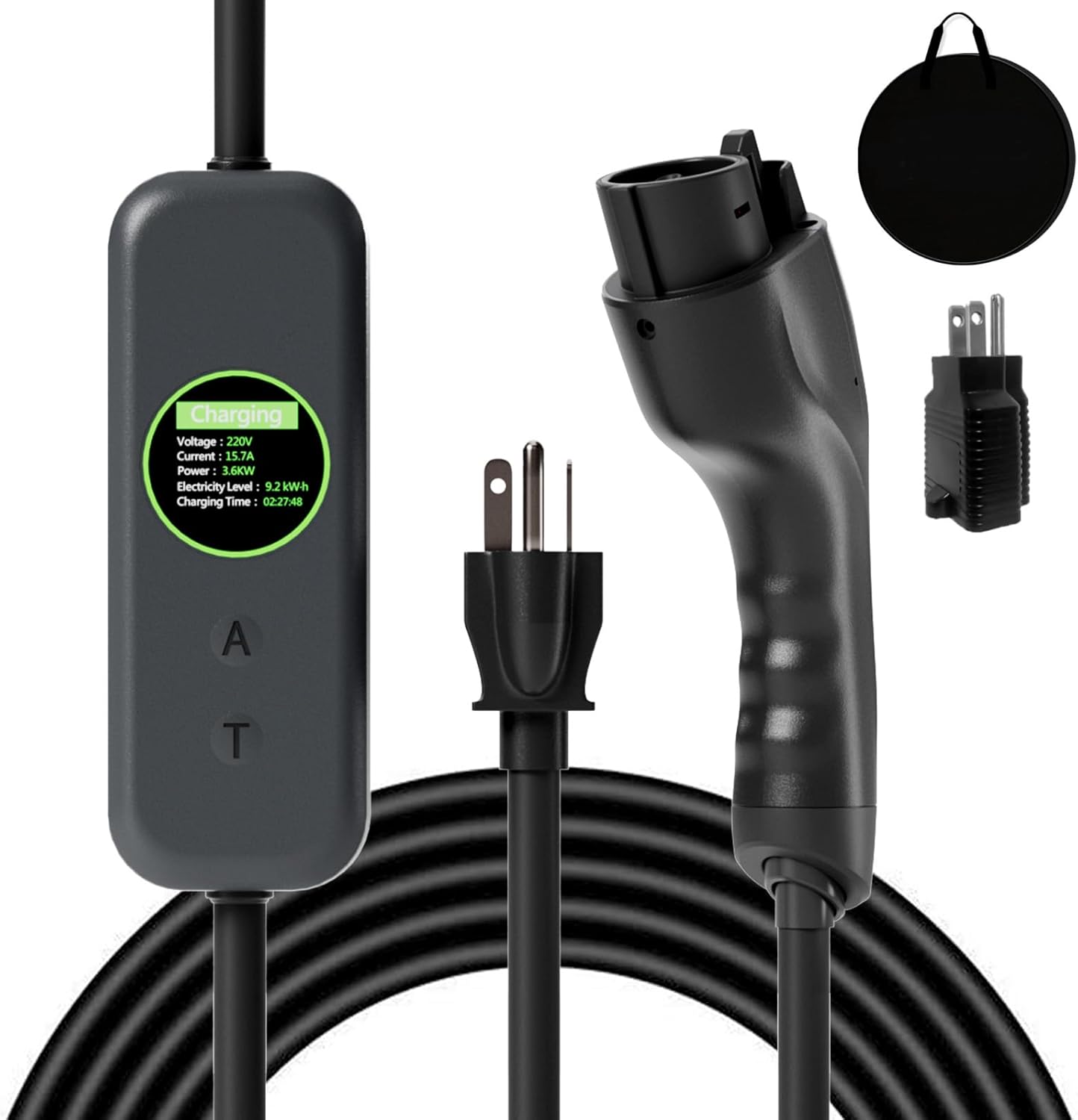
Pros
- Compact and lightweight at under 5 pounds, easy to store in your car trunk or garage
- Simple plug-and-play setup with clear LCD display and intuitive button controls
- Scheduled charging helps you take advantage of lower electricity rates overnight
- Affordable price point makes it an excellent backup or secondary charger for EV owners
Cons
- Cord length is only about 16 feet, which may be too short for some parking layouts
- Some users report the J1772 connector fits tightly in certain vehicles like Toyota bZ4X and Nissan Leaf
- Lacks built-in GFCI protection, so using a GFCI outlet or breaker is recommended for safety
The Toptoo 16A Portable EV Charger is a Level 1+2 electric vehicle charging station designed for EV owners who need a dependable, travel-friendly charging solution. It combines the convenience of a compact portable unit with the performance of a 16-amp, 3.5-kilowatt charger, making it suitable for both everyday home use and on-the-road top-ups. Whether you’re a road tripper, an emergency prepper, or simply an EV driver looking for a backup charger to keep in the trunk, this unit offers a practical balance of features and affordability.
In terms of performance, the Toptoo charger can operate on standard 110V household outlets (Level 1) or 240V NEMA 6-20P outlets (Level 2). At 16 amps and 3.5kW, it adds roughly 12-15 miles of range per hour on a 240V circuit—enough to fully charge many EVs overnight. The adjustable current setting lets you dial down the amperage if your outlet or wiring can’t handle the full 16A, which is a smart safety feature. The LCD color display provides clear real-time data on current, voltage, power, temperature, and charging status, so you always know what’s happening. Scheduled charging is also available, allowing you to set a delayed start or a charging duration limit.
Build quality appears solid based on user feedback. The main control unit feels sturdy, the cable is well insulated, and the internal construction is clean. The 16-foot cord is thick and durable, though some users may find it a bit short for certain garage layouts or public charging scenarios. The J1772 connector is a standard 5-pin design, but a few reviewers noted it can be tight to insert or remove on some models like the Toyota bZ4X and Nissan Leaf. For Tesla owners, an adapter is required (not included). The charger also does not include built-in ground fault protection, so using a GFCI-protected outlet is strongly recommended.
Setting up and using the Toptoo charger is straightforward. Simply plug the control box into the appropriate outlet, plug the J1772 connector into your car, and charging begins. The buttons allow you to adjust the current or set a schedule with ease. The unit is lightweight at just under 5 pounds, making it easy to toss in your trunk or carry to a friend’s house. It’s ideal for EV owners who want a backup charger for road trips, long-distance travel, or emergency situations like power outages when you need to charge from a generator or RV park outlet.
Of course, there are realistic limitations. The cord length is a common complaint—at 16 feet, it may not reach across a driveway or a two-car garage. The connector fit can be snug on some cars, and the lack of built-in GFCI means you’ll want to ensure your outlet has one. A few users also reported the LCD switched to Chinese inadvertently, though this may be a rare issue. Despite these points, the overall value is strong for its price. For EV owners who need a portable, no-frills charger that does the job reliably, the Toptoo 16A is a solid choice—especially if you’re on a budget or want a dedicated travel unit.
In summary, this charger is best suited for EV owners who prioritize portability, simplicity, and cost-effectiveness. It’s a great backup option to keep in your car for road trips, a convenient Level 2 charger for home use if you have a NEMA 6-20 outlet, or a practical solution for emergency charging. Just be aware of the cord length and consider adding a GFCI adapter for extra safety. For the price, it delivers exactly what most drivers need: a reliable way to charge your electric vehicle anywhere with a standard outlet.
Frequently Asked Questions
How does home charging compare to the average electric car charging cost at station?
Home charging is significantly cheaper than public fast-charging networks. Public DC fast stations typically bill premium rates per kilowatt-hour along with session connection fees, whereas residential electricity usually costs a fraction of that amount. Using a portable Level 2 charger at home allows you to schedule charging during super off-peak hours, cutting your total fuel expense dramatically.
Can a 16-amp Level 2 portable charger run on a standard household outlet?
Yes, but only when paired with a NEMA 5-15 adapter at standard 120-volt Level 1 limits. Standard household outlets restrict continuous draw to 12 amps to prevent tripping household circuit breakers under the National Electrical Code. For maximum 16-amp Level 2 output up to 3.8 kW, you must plug the unit into a dedicated 240-volt NEMA 6-20 receptacle.
Are portable J1772 chargers compatible with Tesla vehicles in 2026?
Yes, all standard J1772 charging cables work seamlessly with Tesla vehicles when using a basic adapter. Tesla includes or sells a compact SAE J1772 to NACS adapter that locks directly onto the charging handle. This setup lets Tesla drivers utilize portable Level 1 and Level 2 chargers without damaging vehicle battery management electronics.
Does outdoor weather impact portable EV charger durability?
No, quality portable units with IP65-rated control boxes handle outdoor rain, sleet, and dust without electrical faults. Tough flame-retardant enclosures shield internal components from moisture intrusion during wet driveway charging sessions. Just keep the wall plug connection sheltered or plugged into a weatherproof exterior enclosure to avoid nuisance ground faults.
What should you do if an electric car 12-volt battery dies away from a station?
Auxiliary 12-volt vehicle batteries require a separate low-voltage jump or portable power pack to activate the high-voltage contactors. If the 12-volt system drops voltage completely, knowing how to charge a car battery without a charger can help get safety accessories and vehicle electronics back online. Once the computer boots, the main traction battery can accept current from your portable EVSE unit.



Write Your Review
No reviews yet. Be the first to share your experience!