

Dead phone screens miles past the trailhead create serious stress when navigating routes or documenting camp memories. Natural sunlight provides free energy, but turning raw daylight into dependable juice demands durable off-grid hardware. Packing the best solar powered charger for camping brings reassurance by keeping vital communication links active deep in backcountry zones. Modern gear combines high-capacity battery storage with integrated solar cells for emergency replenishment right at your tent site. If you regularly pack a standard portable charger for travel, stepping up to a solar-assisted battery adds crucial reliability during delayed departures.
Evaluating outdoor power gear requires balancing substantial storage reserves against trail-ready carry weight. Rugged shells with IP65 water resistance defend internal circuits against sudden downpours and campsite dirt. Integrated charging cables and PD 22.5W fast charging ports replenish phones and headlamps without cord clutter. Compact solar cells mainly provide emergency trickle power, so pairing high internal capacity with wall and solar recharging makes these packs reliable companions for any journey.
Pros
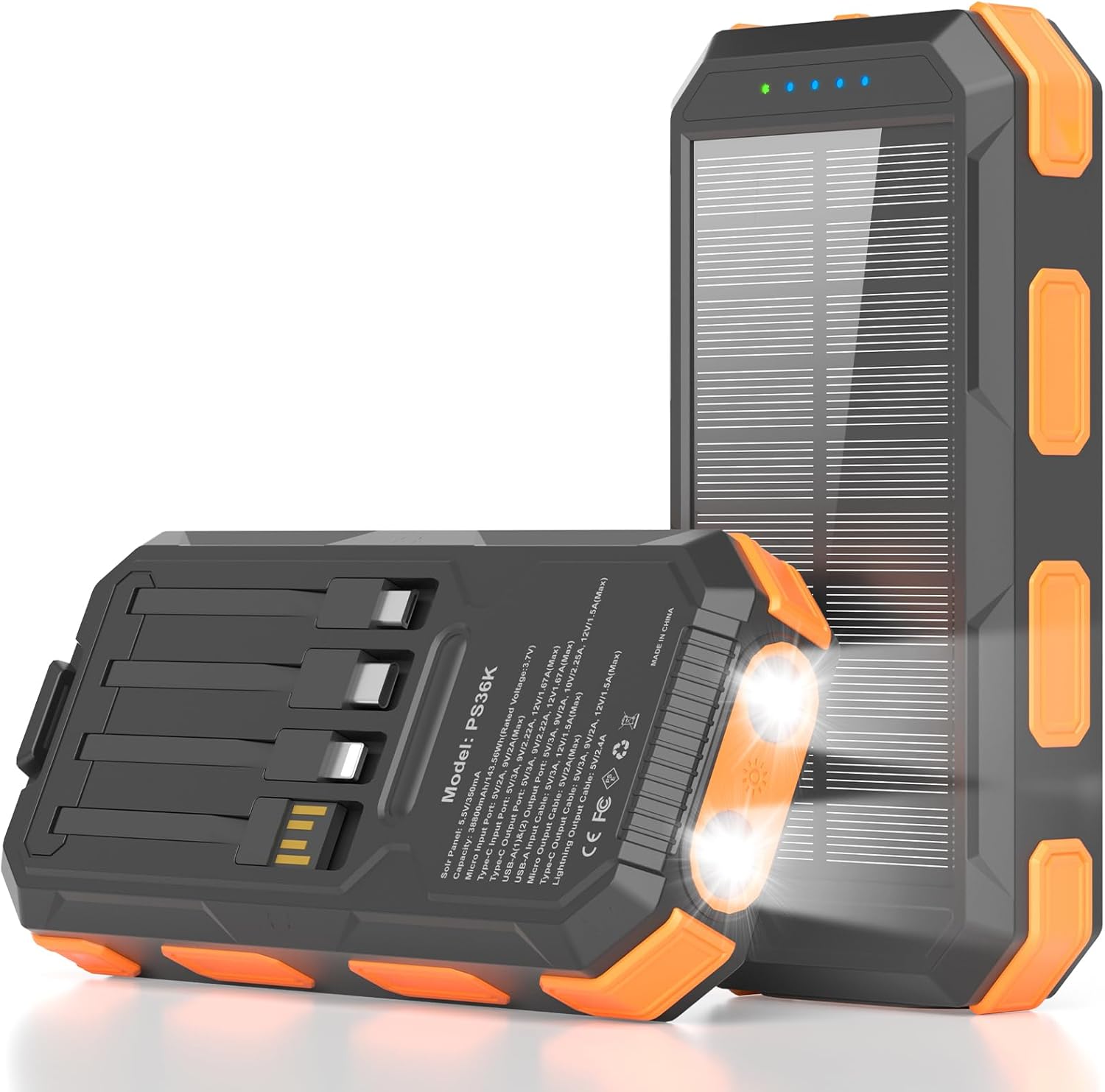
- Huge 38800mAh battery capacity provides multiple full charges for most smartphones (e.g., 6-7 charges for an iPhone 15).
- Built-in cables eliminate the need to carry separate charging cords – a huge convenience for travel and outdoor gear.
- Rugged IP65 construction and silicone bumpers withstand rain, dust, and drops, ideal for camping, hiking, and job sites.
- Dual flashlight with SOS mode adds practical emergency lighting without needing a separate headlamp or lantern.
Cons
- Solar charging is very slow – it only provides a trickle charge and requires direct sun for many hours (best used as a backup recharging method).
- Weight of 1.1 pounds is a bit heavy for ultralight backpacking, but manageable for camping or car travel.
- No wireless charging pad or higher-wattage USB-C PD (limited to 22.5W), so laptops may not charge efficiently.
The YELOMIN Solar Power Bank is a portable battery pack designed to keep your devices powered during outdoor trips, emergencies, or daily commutes. With a large 38800mAh capacity, it stores enough energy to charge a smartphone several times or a tablet at least once. This makes it a practical choice for campers, RV owners, hikers, and anyone who spends time away from wall outlets.
This power bank is best suited for outdoor enthusiasts and emergency preppers who need a reliable backup power source. Its IP65 waterproof rating and shockproof silicone corners allow it to handle rain, dust, and accidental drops – common challenges when camping, tailgating, or working on a construction site. The built-in 1.8W dual flashlight with SOS mode adds extra safety for night-time activities or power outage situations.
In terms of performance, the battery delivers up to 22.5W fast charging via the USB-C port, which can quickly replenish modern smartphones and tablets. The built-in cables (Type-C, iOS, and Micro USB) mean you don't need to dig around for cords – just plug and charge. Three additional output ports let you charge up to six devices at once, which is handy for families or group trips. Note that solar charging is a trickle process: it works in direct sunlight but will take many hours to fully recharge the 38800mAh pack. The product description correctly warns that solar should be seen as an emergency or supplementary charging method, not a primary one.
Build quality is solid for the price. The ABS and silicone construction feels durable, and the port covers keep debris out. The power bank includes overcharge, short circuit, and temperature protection, which helps safeguard both the battery and your devices. The included lanyard makes it easy to hang from a backpack or tent hook during use.
Storage and maintenance are simple – just keep it partially charged when not in use and recharge it every few months to maintain battery health. The unit measures 6.3 x 3.07 x 1.38 inches and weighs 1.1 pounds, so it fits easily in a daypack or car console without being too bulky.
Some realistic limitations include the slow solar recharging and the lack of high-wattage USB-C for laptops. The weight may also be noticed by ultralight backpackers. However, for most campers, road trippers, tailgaters, and emergency preppers, this solar power bank offers a dependable, versatile power solution at a reasonable price. If you need a long-lasting backup for phones, headphones, and small USB gadgets, the YELOMIN is worth considering.
Frequently Asked Questions
How does solar trickle charging work on a solar power bank?
Solar trickle charging feeds a low-amperage current from the built-in photovoltaic cell directly into the internal battery. Because compact cells have small surface areas, they generate modest wattage compared to full-sized panels. This feature serves primarily as emergency backup when electrical outlets are unavailable. Setting the battery under direct sunlight ensures the steadiest off-grid trickle.
Can the best solar powered charger for camping handle rain and rough camp environments?
Yes, rugged battery packs featuring IP65 water resistance withstand water splashes, heavy rain, and trail grit. Tough ABS construction and thick silicone bumper corners cushion the unit against accidental drops on rocky terrain. Tight port seals prevent moisture from reaching vulnerable USB connections. Users should verify that all rubber port covers remain firmly closed around water.
How many devices can you charge simultaneously off the battery?
Many multi-port solar banks power up to six devices simultaneously using integrated cables and external USB ports. Built-in Type-C, Lightning, and Micro USB cords eliminate loose cable mess around your sleeping bag. Fast-charging outputs deliver swift power to compatible smartphones and headlamps. Reviewing how many volts in a phone charger helps match appropriate power levels to delicate outdoor gear.
Why does a solar battery bank charge slower behind vehicle glass?
Window glass reflects and filters solar radiation, reducing solar cell conversion efficiency by significant margins. Factory window tinting blocks the exact light frequencies that photovoltaic panels need to generate electricity. Enclosing battery packs behind hot glass also traps intense ambient heat, risking internal cell degradation. Placing the charger outdoors in unobstructed air delivers faster, safer solar absorption.
What is the main difference between a solar power bank and a folding panel?
A solar power bank stores electrical current in an onboard lithium battery, whereas a folding solar panel generates live electricity only under daylight. Standalone folding arrays provide higher wattage output, but they cannot save energy for nighttime camp chores. An integrated power bank delivers stored power on demand after sunset. Combining both options provides total energy independence on extended expeditions.



Write Your Review
No reviews yet. Be the first to share your experience!